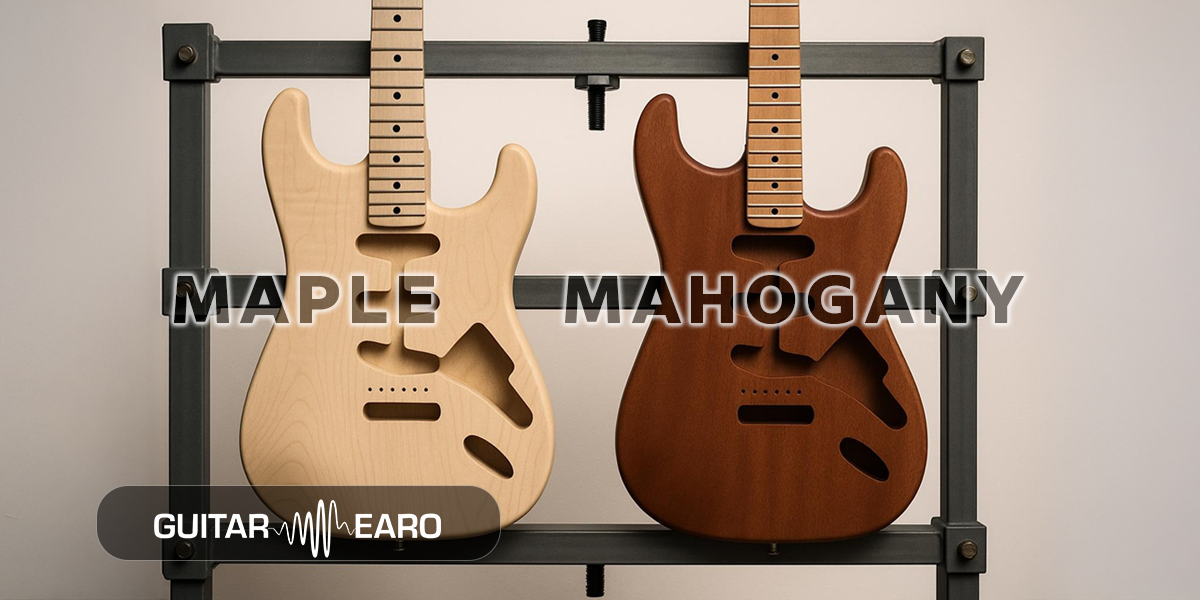
Maple vs mahogany is the wood debate most shoppers know. Maple sounds bright. Mahogany sounds warm. Forums turn that into destiny: “match pickups to your tonewood.”
On solid-body electrics, the useful truth is smaller and sharper:
- Wood can nudge envelope and spectral balance in controlled tests.
- Pickups, construction, and gain usually swamp species in real playing.
- You cannot reliably hear “maple vs mahogany” alone in a blind test. Guitar Earo’s courses treat that as honesty, not heresy.
This piece ties research, Gibson’s maple-cap origin story, and app training into one shopping frame.
The archetype: why Les Paul is the maple vs mahogany lesson
Gibson’s late-1950s R&D, documented in Guitar Earo’s Amplified / Holy Trinity research, is the textbook case:
- All maple prototypes: too sharp, long ringing.
- All mahogany: too soft or muddy for the target voice.
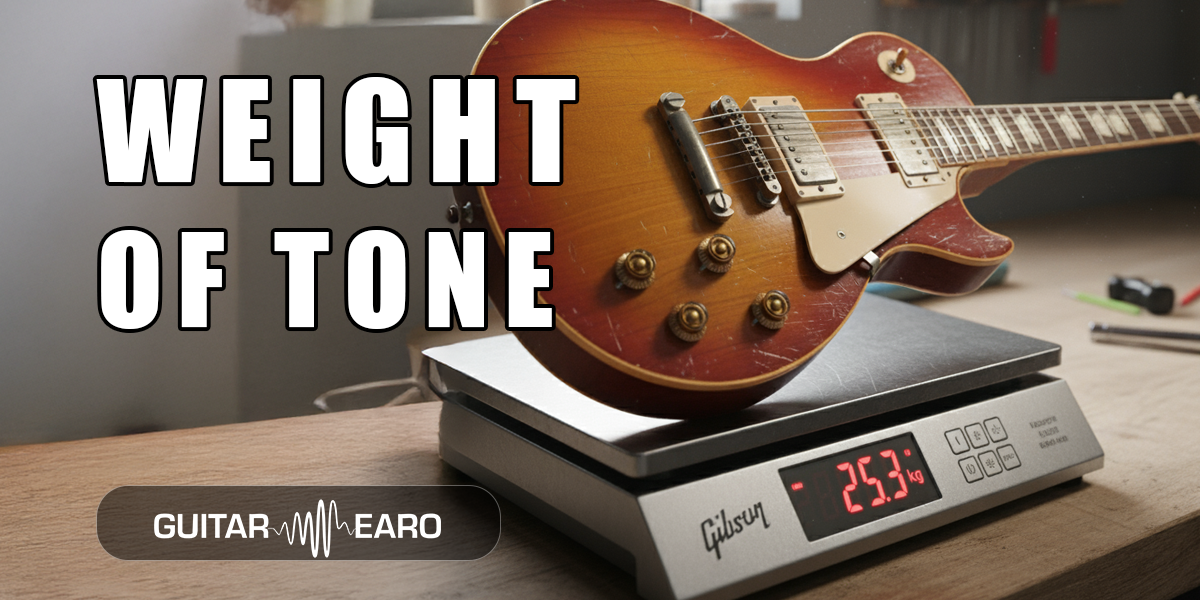
- Maple cap on mahogany back: brightness and sustain feel without losing warmth or manageable weight.
Ted McCarty’s team was not decorating; the cap sat under finish on Goldtops. The goal was tonal balance. The 1954 Custom later went all-mahogany on purpose for a darker voice. Proof the recipe is a design choice, not a law of nature.
Electric Guitar and Bass Design states the designer’s dilemma plainly: imagine maple neck + mahogany body, brightness meets warmth, but neck-through vs bolt-on can cancel expectations. Lutherie is not one-variable science.
Maple: what it tends to mean in builds
In builder language (and EG&B’s wood chapter):
- Hard maple: stiff, bright tendency, close grain (finishing-friendly).
- Often used for necks, caps, fretboards (with brightness and attack in the legend).
- Contributes to visual “flame” figure; aesthetics drive price as much as sound.
Research digests note maple vs mahogany bodies showing small spectral differences (on the order of a few dB in bands) in lab rigs. Sometimes above timbre JND in controlled listening, often below practical notice once amplified with gain.
Maple’s stiffness links to sustain talk in design texts, but stiffness ≠ heavy. Do not confuse with heavier = more sustain.
Mahogany: warmth, weight, and the “wood & weight” family
Mahogany (and mahogany-like substitutes) anchor US Set solids:
- Les Paul: dense feel, strong mids, humbucker weight in Guitar Earo’s mnemonic.
- SG: lighter solid, faster attack, more bite. Same family, different branch.
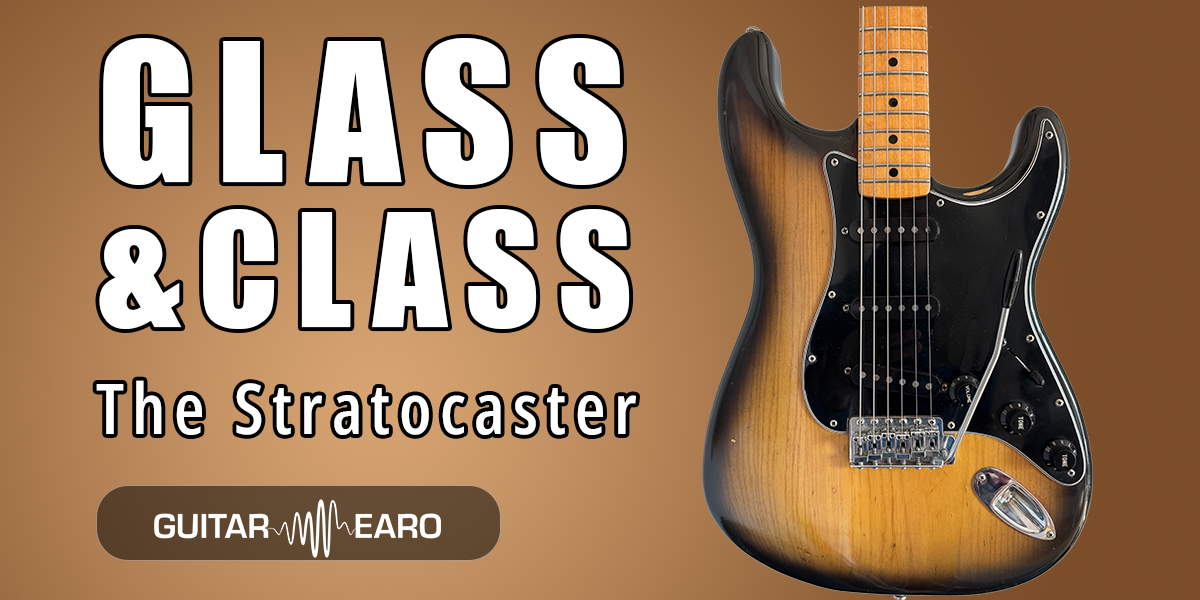
The app’s Wood & Weight: the Les Paul deck trains thick, dense, sustaining character vs Strat glass. That is family + pickup + construction, not a wood ID exam.
Mahogany adds mass on the strap. Les Paul development literally moved away from too heavy all-mahogany bodies toward sandwich builds.
Maple vs mahogany: compare the right layers
| Question | Maple tendency | Mahogany tendency |
|---|---|---|
| Shop talk | Bright, snappy | Warm, round |
| Typical use | Caps, necks, some bodies | Bodies, some necks |
| With same pickups | Slightly more top in some tests | Slightly fuller low-mid in some tests |
| Under high gain | Often masked | Often masked |
| Blind species ID | Unreliable | Unreliable |
Neck wood vs body wood vs cap are three variables. A maple fretboard on a mahogany body with humbuckers is not “a maple guitar.”
What research argues about (solid) tonewoods
Guitar Earo’s research archive summarizes the fight:
- Skeptics: pickups, amp, pedals, cable dominate; species is marketing.
- Traditionalists: resonance and sustain still matter even amplified.
- Measured middle: differences exist in lab and DI-adjacent conditions; gain and mix shrink them.
Electric Guitar and Bass Design is blunt for electrics: influence is subtle if not imperceptible, non-regressive (cannot identify species by ear alone), and relative to pickups and electronics. It also warns against endangered-wood mythology, ethics aside from tone.
Guitar Earo’s Why Wood Debates Collapse deck (Tone Judgement) states the practice rule: under gain, do not use wood as a primary judgement cue. Focus on what survives: pickup type, position, construction, bridge stability.
How to compare maple vs mahogany fairly
- Same pickup type and position: HB vs HB, not HB vs single-coil.
- Same construction class: solid vs solid.
- Same signal path: both DI or both mic’d identically.
- Clean and edge-of-breakup: gain hides wood.
- Instant A/B: memory lies on back-to-back days.
How Guitar Earo teaches it
Tone Orientation
- Anatomy of Tone: three building blocks before wood names.
- Wood & Weight: the Les Paul: mahogany-associated density and sustain feel vs other families.
- Guitar Families exam: Weight vs Glass drills (Les Paul vs Strat).
- Construction Concepts: Wood’s Subtle Influence, Envelope Beats EQ.
- History, Template Lock-In: US Set mahogany + maple cap philosophy vs US Bolt bright bolt-on platform.
Tone Discrimination
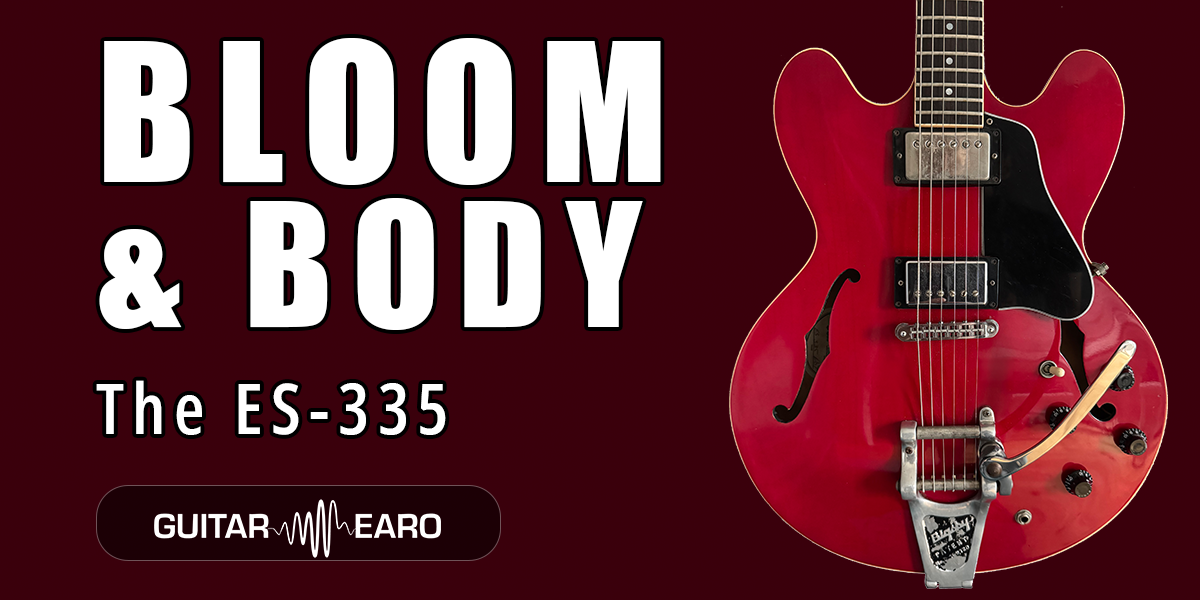
- US Set Branching: Les Paul vs SG vs Semi-Hollow: same humbucker DNA, weight vs bite vs bloom.
Tone Judgement
- Why Wood Debates Collapse: honest boundary under masking.
You learn family and construction first, wood lore second.
What to do next
If you are choosing between a maple-cap LP-style build and an all-mahogany variant, listen for mid presence and decay shape on matched clips, not brand storytelling.
For maple neck vs mahogany body debates, shrink the claim: one part cannot define the whole system.
Train Wood & Weight and US Set Branching in Guitar Earo, and read Maple Tonewood Characteristics for maple-specific detail.
Download the app. 7-day free trial, instant A/B, then learn what survives the amp.