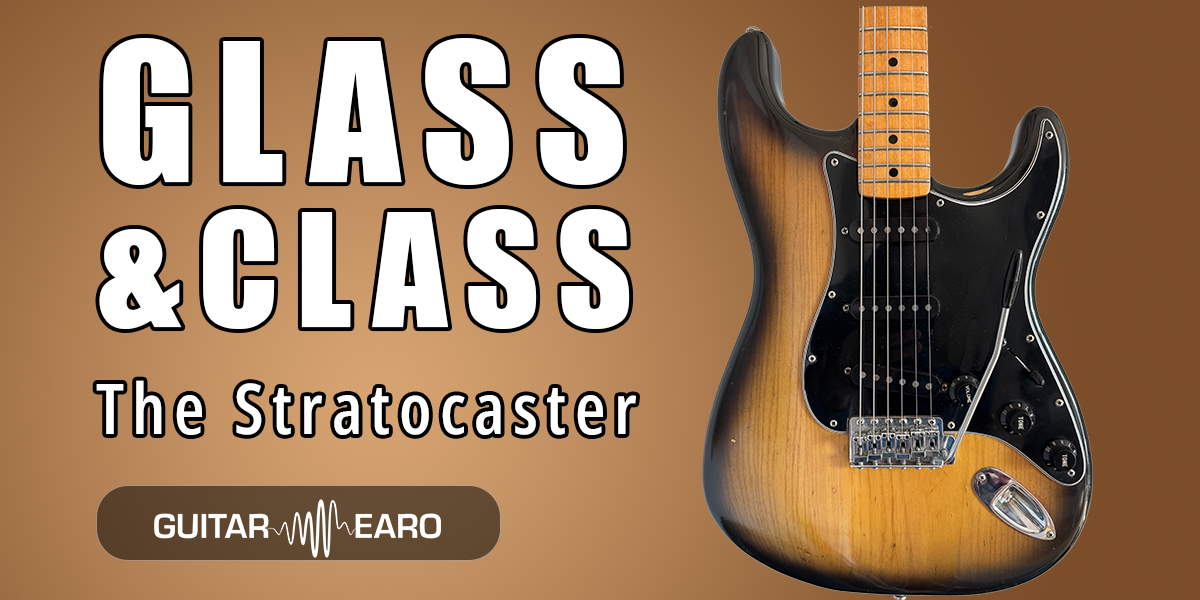
The Stratocaster is the guitar everyone thinks they know. Three single-coils, a whammy bar, sunburst finish — check the boxes and move on. That checklist is how buyers end up with the wrong Strat, or with a Tele they mistook for “bright enough.”
The Strat is not “a bright guitar.” It is a glass-and-class instrument: smooth, bell-like clarity with a complex top end that stays recognizable even when the amp changes. Hear that identity clearly and you can shop with confidence. Hear only “single-coil” and you are back to guessing from photos.
This article maps the Strat’s anatomy of tone — the same frame as our Anatomy of Tone lesson, applied to the most copied solidbody ever — and shows how Guitar Earo trains it in the app.
Glass and class: the family identity
In Guitar Earo’s Tone Orientation course, the Strat sits in the Guitar Families chapter under one mnemonic: glass and class.
- Glass — smooth, bell-like clarity; a complex top end that can read transparent or cutting depending on position and gain.
- Class — versatility without losing identity; the Strat stays recognizable from clean chords to edge-of-breakup leads.
The opposite confuser in that chapter is the Telecaster’s twang and toughness: sharp bite, snap, and a more fundamental attack. Where the Tele snaps, the Strat shines. That contrast is not subtle once you A/B the same riff on matched recordings — but it vanishes when demos use different players, days, and rigs.
Weight vs glass is the other axis learners drill early: Les Paul humbucker weight (thick, dense, sustaining) versus Strat glass (clear, present, single-coil air). Shoppers who only compare “single-coil vs humbucker” miss the family story. A Strat neck can feel warm; it will not sound like a Les Paul neck.
The three building blocks on a Strat
Every electric guitar tone breaks down into pickup position, pickup type, and body construction. On a classic SSS Strat, all three work together.
Pickup type: three single-coils
The Strat’s DNA is three single-coil pickups. That means clarity, pick attack in the mix, and the upper-mid/treble presence people call “glassy.” Hum is part of the design — useful as a clue in training, not as a moral verdict.
Hybrids matter when you shop. HSS Strats put a humbucker at the bridge. In the app’s Tone Judgement track, that bridge position is a deliberate category jump: at position 5 you are hearing humbucker density, not “Strat glass,” even though the body is still a bolt-on Strat. Classify by pickup type first, then family — or you will mis-label every HSS bridge clip as “bright Strat.”
Pickup position: five voices, not one “Strat sound”
A Strat is really five stable selector voices:
| Position | What you hear | Role |
|---|---|---|
| 1 — Neck | Warmth, roundness, sustain-friendly | Rhythms, lyrical leads |
| 2 — Neck + middle | “Quack”: phasey, nasal, hollow | Funk, pop, Mark Knopfler territory |
| 3 — Middle | Even, slightly hollow, less extreme than 2 or 4 | Comping, balanced clean |
| 4 — Middle + bridge | Quack again, brighter than 2 | Cutting clean, chime |
| 5 — Bridge | Brightest, most cutting glass | Leads, bite, country-rock edge |
Positions 2 and 4 are the Strat’s secret weapon. Players wedged the old 3-way switch between detents for decades; Fender formalized it as the 5-way in 1977. The quack — phase cancellation between two coils — is not “neck plus bridge averaged.” It is its own timbre: nasal, phasey, instantly Strat.
Neck vs bridge on the same Strat is the first position drill in Pickup Drill: neck warmth versus bridge glass. If you only test position 5 in the store, you may conclude the guitar is “too bright” when position 1 was what you needed.
Body construction: solid bolt-on platform
The Strat is a solid alder or ash body with bolt-on neck — the “US Bolt” template in later courses. Stable attack, controlled resonance, less acoustic bloom than a hollow ES-style guitar. The vibrato adds mass and coupling; it is part of the feel, but the glass identity survives typical amp settings.
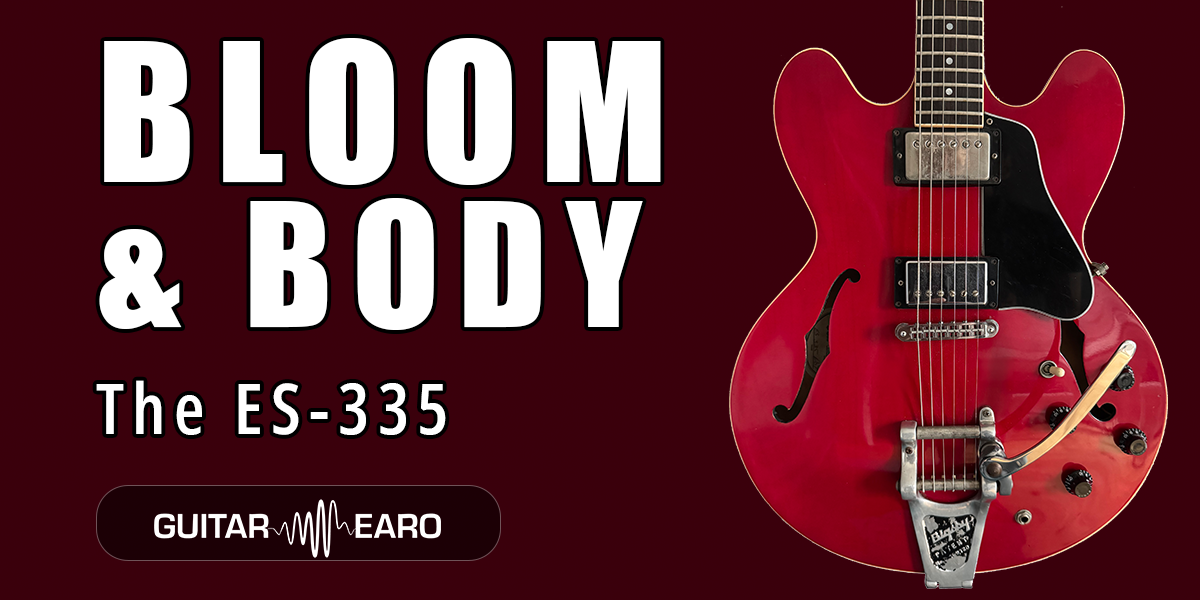
Semi-hollow and hollow guitars can swell and bloom in ways a Strat will not. Comparing a Strat to an ES-335 on YouTube without matched takes usually compares construction families, not “which is better.”
What shoppers get wrong
- “Bright = Tele” — Both families can be bright. Strat bridge is glass and complex; Tele bridge is snap and fundamental. Brightness alone is a trap.
- One position = the guitar — Judging a Strat only on the bridge pickup is like judging a car only in sixth gear.
- Ignoring quack — If you never use positions 2 and 4, you are not hearing a large part of why players choose a Strat.
- HSS blind spot — A humbucker bridge on a Strat body is still a humbucker at the bridge. Family bias misleads.
- Logo listening — Headstock and finish change nothing about the matched waveform.
How Guitar Earo teaches it
Training follows the same progression as the course path in guitar-earo-assets, from vocabulary to judgment.
Tone Orientation (Course 1)
- Anatomy of Tone — Pickup position, pickup type, and body construction as the universal frame (the lesson behind our first Science article).
- Guitar Families — Glass & Class: the Strat — Introduces glass vs Tele twang and Les Paul weight with instant A/B on the same performances. You learn family first: identify Strat, then worry about position.
- Pickup Drill — Strat positions 1–5, including quack on 2 and 4, neck vs bridge across DI and amp, and noise-as-clue for single-coil vs humbucker.
- Integrated Mastery — Two-step method: family (Strat vs Tele vs Les Paul), then position (neck vs bridge). Exams include confusers like “Tele bridge vs Strat bridge” so you cannot cheat with brightness.
Tone Discrimination (Course 2)
Refines confusers: Tele vs Strat (snap vs glass), Strat quack vs Tele both-pickups blend, Strat vs ES-335, Strat vs superstrat output. You are not re-learning labels — you are separating similar clips under time pressure.
Tone Judgement (Course 3)
Full-stack decisions: family, pickup type, position, and context. The HSS bridge trap deck exists because real-world shopping includes hybrid Strats. Override “it’s a Strat” when the bridge pickup is a humbucker.
Across all three courses, comparisons use matched recordings from documented instruments (including a vintage 1976 Strat and a 2005 60s reissue in the library) so you hear the guitar, not the demo rig.
How to compare a Strat fairly
Before you trust a clip or walk into a store:
- Same performance — identical part, picking, and level.
- Same signal path — both DI or both mic’d the same way.
- Test more than one position — at minimum neck (1), quack (2 or 4), and bridge (5).
- Immediate A/B — switch while your ear still holds the first take.
- Hide the logo — glass vs twang is humbling when the headstock is invisible.
Guitar Earo’s library is built for this: instant switch between matched takes so you compare voice, not influencer tone.
What to do next
If you already read Anatomy of Tone, you have the frame. Apply it to the Strat: hear glass and class as a family, then map the five positions — especially the quack in between.
In the app, start with Glass & Class: the Strat in Tone Orientation, then run the Pickup Drill chapter until positions feel like distinct voices, not one knob setting.
Choose the right Strat before you spend. That starts with hearing glass — and knowing which position is speaking.
Download Guitar Earo and try the 7-day free trial — compare Strats with instant A/B, then learn what you are listening for.