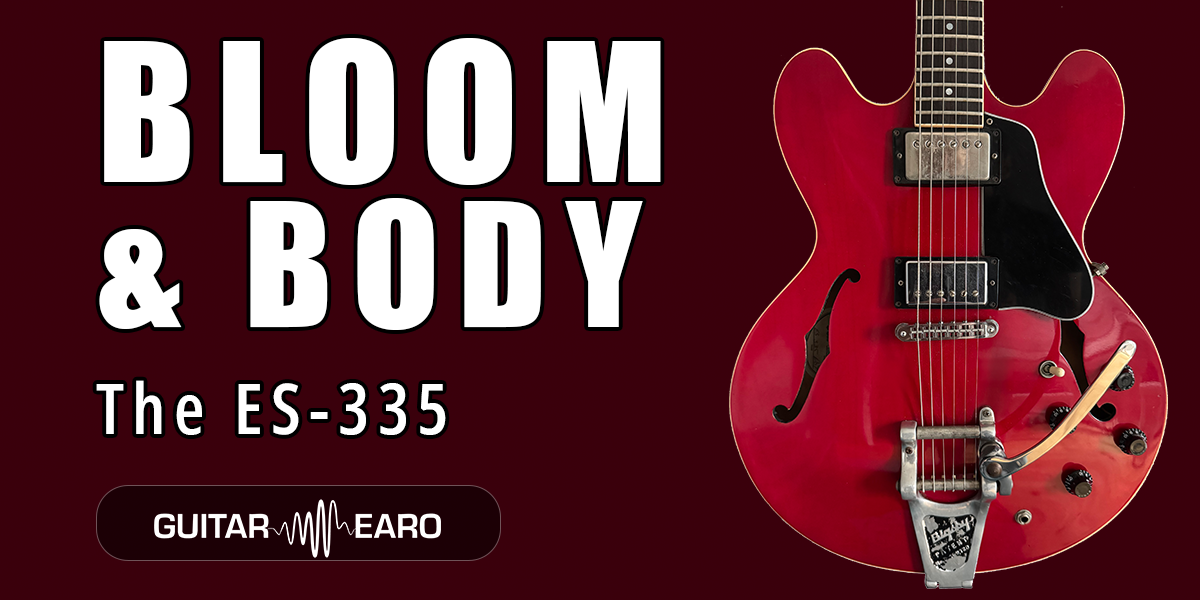
The ES-335 is the guitar people buy when they want “Les Paul warmth without the weight.” Then they plug it in and wonder why it feeds back at the gig, or why it does not sound like the humbucker solidbody in the demo.
Both reactions are fair. The ES-335 is not a lighter Les Paul. It is a semi-hollow with humbuckers — and the sound that matters is not the pickup label on the spec sheet. It is bloom and body: delayed energy return from air and wood coupling, in a package that still behaves like an electric when you turn up.
This article maps the ES-335’s anatomy of tone — the same three-building-block frame as Anatomy of Tone, focused on the semi-hollow that defined “airy electrics” — and shows how Guitar Earo trains it in the app.
Bloom and body: the family identity
In Tone Orientation, the ES-335 anchors the Airy Electrics deck in the Guitar Families chapter. The mnemonic on our lesson card is bloom and body:
- Bloom — a timing cue, not an EQ trick. After the attack, the note can swell slightly as energy returns from the body and air chambers. The note feels like it is growing.
- Body — the semi-hollow platform: humbucker warmth and sustain, but with coupling into air that a solid slab does not share.
Fully hollow guitars (like an ES-125 in the library) push further: more resonance, more movement, more feedback readiness. The ES-335 sits in the middle — controlled bloom: some air, still usable on stage.
Solids are the contrast. Tele, Strat, and Les Paul share immediate attack and stable decay. When you A/B the same chord progression on matched recordings, the ES-335 is the one that returns energy a beat late. Miss that envelope and you will shop on humbucker reputation alone.
The three building blocks on an ES-335
Body construction: semi-hollow with a center block
This is the ES-335’s superpower and its trade.
A semi-hollow routes string energy into wings of air and wood, while a center block tames the wildest hollow-body feedback. You get bloom without fully surrendering control. Construction is why the 335 survives jazz clubs, blues stages, and rock rigs where a fully hollow box would fight you.
In Construction Concepts, Guitar Earo treats bloom as envelope behavior — attack, sustain, decay over time — not “more bass on the tone knob.” A bright semi-hollow can still bloom; a dark solid can still stay stable. When you evaluate gear, listen for whether the note opens after the pick attack. That cue survives amp changes better than forum EQ myths.
Construction first, family second is drilled in integrated mastery: semi-hollow vs solid before you name Les Paul vs ES-335. Air and bloom are system cues, not model quirks.
Pickup type: humbuckers — but not “Les Paul tone”
Classic ES-335s carry dual humbuckers: thick mids, strong fundamentals, less single-coil air than a Strat. That overlap tricks buyers.
The fix is to compare construction under the same pickup family. Les Paul and ES-335 both use humbuckers; the Les Paul is weight and focus (dense solid, immediate envelope). The ES-335 is bloom and air (semi-hollow swell). Same pickup type, different coupling — exactly what the US Set Branching deck in Tone Discrimination trains: Les Paul weight, SG bite, ES-335 bloom.
Pickup position: three voices on one template
Like other US Set guitars, the selector gives discrete positions — neck warmth, bridge cut, and a blended middle that is its own voice, not a linear average. On the 335, those positions ride on top of the semi-hollow envelope.
Train neck vs bridge on the same guitar before you compare brands. A bridge-heavy shopper who only tests position 3 on a Les Paul will misread position 5 on a 335 as “the whole guitar.”
What shoppers get wrong
- “Humbucker = Les Paul” — Pickup type is one block. Construction is another. The 335 proves they diverge.
- Judging bloom on a dirty demo — Under gain, semi-hollow coupling can read as instability or feedback tendency. That is real (and taught in Semi Under Gain in Tone Judgement), but it is not the same as “no bloom on clean.” Test clean and edge-of-breakup too.
- Comparing to a Strat on brightness — The 335 is not “bright single-coil.” Strat vs 335 is glass vs bloom, SC vs HB, solid vs semi.
- Ignoring vibrato vs stop-tail variants — Bigsby vs stop-tail is a micro-discrimination in later courses: same template, different coupling and attack. Worth hearing if you are down to two listings.
- Skipping matched A/B — Different rigs hide the swell that defines the purchase.
How Guitar Earo teaches it
Training follows the course path in the app, from vocabulary to judgement.
Tone Orientation (Course 1)
- Anatomy of Tone — Pickup position, pickup type, body construction (including solid vs semi-hollow bloom in the foundations exam).
- Airy Electrics — ES-335 bloom vs Les Paul stability, vs Tele solid attack, with instant A/B on the same performances (1986 ES-335 with Bigsby in the library).
- Construction Concepts — Solid vs semi vs hollow axis, bloom vs stability, envelope beats EQ.
- Integrated Mastery — Construction first (semi vs solid), then family; ES-335 vs Holy Trinity confusers.
Tone Discrimination (Course 2)
US Set Branching refines Les Paul vs SG vs ES-335 on the same humbucker DNA. Exams include ES-335 (vibrato) vs stop-tail micro-discrimination and Strat vs 335 family calls under time pressure.
Tone Judgement (Course 3)
Semi Under Gain: ES-335 vs Solid — when bloom becomes feedback readiness, and why high-gain contexts favor solids. Full-stack trials still ask you to hear semi vs solid on rock riffs, not just clean jazz chords.
Across courses, comparisons use matched recordings so you hear coupling and envelope, not the demo player’s pedalboard.
How to compare an ES-335 fairly
- Same performance — identical part, picking, level.
- Same signal path — both DI or both mic’d the same way.
- Test clean and light drive — bloom shows in the envelope, not only in the amp’s gain LED.
- A/B against a solid humbucker — Les Paul or similar, not only a Strat.
- Immediate switch — hold the first clip in memory while you toggle.
Guitar Earo is built for this: instant switch between matched takes so you compare bloom vs stability, not influencer tone.
What to do next
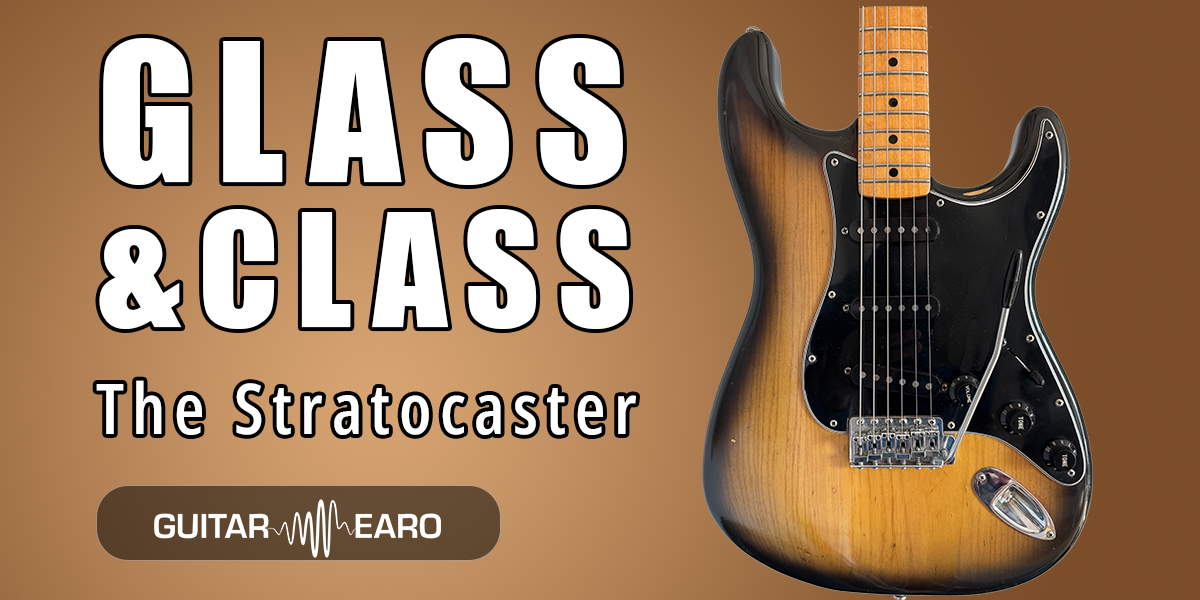
If you have read Anatomy of Tone and Glass & Class: The Stratocaster, you already have two anchors on the family map. Add the third: semi-hollow bloom.
In the app, open Airy Electrics in Tone Orientation, then run US Set Branching when you are ready to separate 335 from Les Paul on the same pickup type.
Choose the right semi-hollow before you spend. That starts with hearing bloom — and knowing it is not a heavy Les Paul.
Download Guitar Earo and try the 7-day free trial — compare ES-335 clips with instant A/B, then learn what you are listening for.