Search traffic around “pickups layered or scatter” usually means one question: does the way the wire is wound onto the bobbin change tone as much as the ads claim?
Yes, but through physics you can measure, not magic you can smell. Scatter winding and tight machine layering are two ways to build the same magnet-and-coil transducer. They mainly shift distributed capacitance, which moves the pickup’s resonant peak. Everything else still dominates the story: magnet, turn count, wire gauge, placement, cable, amp.
Layered winding: the factory default
Machine-layered coils wind wire in orderly rows. Turn spacing is consistent. That predictability keeps inductance and DC resistance within spec from unit to unit.
In design terms, a tighter pack can raise self-capacitance in the coil. Capacitance teams with inductance to set where the pickup rings brightest. Helmuth Lemme’s pickup primer (reproduced in Electric Guitar and Bass Design) stresses that inductance and resonant frequency explain most of what we call “pickup tone,” not resistance alone, and not magnet alloy slogans in isolation.
Layered winds are why two “identical” off-the-shelf pickups can still sound alike: the transfer curve is repeatable.
Scatter winding: irregular layers on purpose
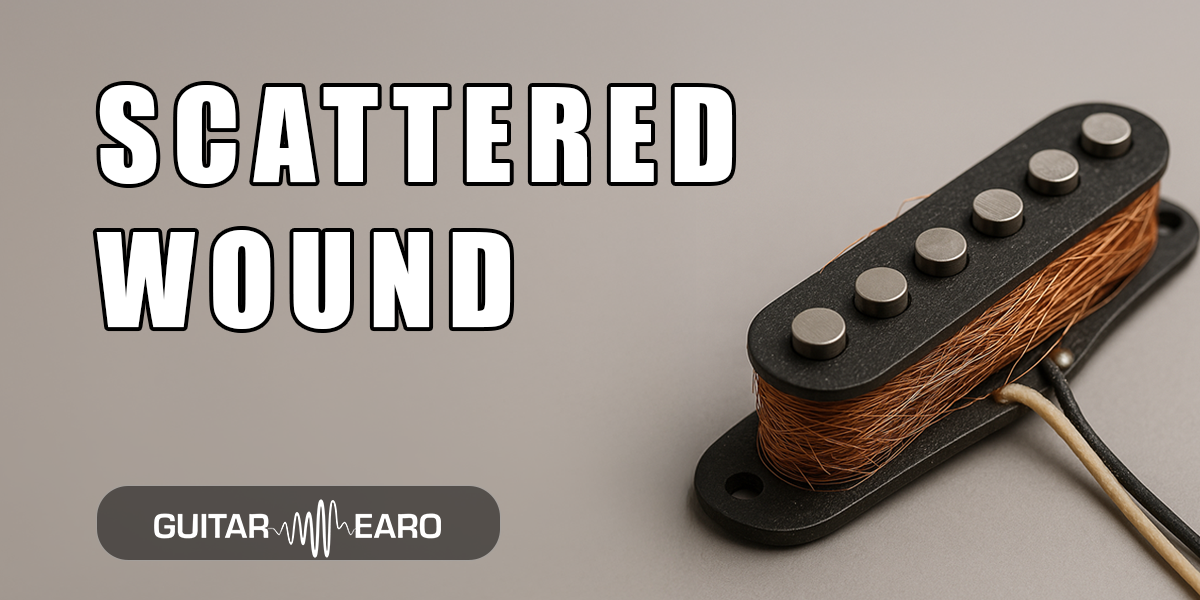
Scatter-wound pickups deliberately vary turn placement. Wire does not sit in perfect layers; spacing fluctuates. Boutique makers often hand-guide the wire for this reason.
Research summarized in Guitar Earo’s design notes (including Lockyer’s winding primer and recent preprints on winding randomness) points to a consistent mechanism:
- More average space between turns lowers distributed capacitance (often cited around 10–15% vs a tightly wound coil of the same spec).
- Lower capacitance shifts the resonant peak upward, sometimes a few hundred hertz on a Strat-style single-coil.
- Subjectively: a slightly brighter, more open top before roll-off, not automatically “hotter.”
Example from that literature: a uniform Strat coil might peak near 6.5 kHz; a scatter-wound sibling with matched turns might land nearer 7 kHz with a somewhat broader peak. You are hearing EQ shaped by resonance, not a separate flavor bolted on.
Each scatter unit also varies microscopically. Placement differences unit to unit fuel the “this one’s special” lore. Blind tests often shrink the gap when inductance, resonant frequency, and load are matched.
Layered vs scatter: what actually moves
| Factor | Layered (tight) | Scatter (irregular) |
|---|---|---|
| Unit consistency | High | Lower |
| Coil capacitance | Often higher | Often lower |
| Resonant peak | Often lower | Often higher |
| Treble feel | Can be warmer/softer | Can be more present |
| Myth surface area | “Cold and sterile” | “Hand-wound mojo” |
Neither label replaces pickup family. A scatter-wound humbucker still behaves like a humbucker. A layered single-coil still hums like a single-coil.
The system pickup lives in
Electric Guitar and Bass Design argues for an integral view: pickup + volume/tone pots + cable capacitance + amp input impedance = one system. Swap cable length and you move the peak. Swap pot value and you move the peak. Judging scatter vs layer on a demo with a different cable than your rig compares two different systems.
Practical checklist:
- Match pickup type (single-coil vs humbucker) before wind style.
- Compare at the same gain structure (clean vs edge-of-breakup).
- Hold cable and volume constant.
- Listen for presence band change, not just “louder.”
What Guitar Earo trains first
The app does not ask you to identify “scatter” by ear on day one. It builds the hierarchy that makes winding debates survivable.
Tone Orientation: Anatomy of Tone & Pickup Drill
- Pickup type (single-coil vs humbucker) in the Anatomy of Tone chapter: clear vs thick, grain vs sheet under gain later.
- Pickup Drill: neck vs bridge, Strat positions, Les Paul 3-way states. You learn where the string is read before how the coil was wound.
Tone Discrimination: Pickup Type Under Masking
- Decks like Pickup Type Beats Family When Masking Rises force SC vs HB calls when brightness collapses. That is the skill scatter debates assume you already have.
- Strat HSS Bridge Is a Category Jump: bridge humbucker density vs SSS glass. Winding style never overrides that.
Tone Judgement: Advanced Wiring (concept)
- Advanced Wiring Universe (info cards) maps coil-split, series/parallel, and phase. Electrical paths that change inductance and peak as much as wind technique.
When you do audition custom pickups, Guitar Earo’s library lets you compare matched performances so you hear whether a brighter peak is real or rig change.
What to do next
If you are shopping hand-wound scatter units, ask for inductance, resonant frequency, and wire gauge, not only DC resistance. A/B against a known reference on the same cable.
Train pickup type and position in the app first. Winding nuance sits on top of that stack, not beneath it.
Download Guitar Earo and try the 7-day free trial. Instant A/B on pickup families, then learn what you are listening for.