In 1962, Leo Fender was trying to build the world’s most advanced electric guitar.
He called it the Jaguar, a sleek, chrome-covered machine that looked like the future and, in many ways, sounded like it too.
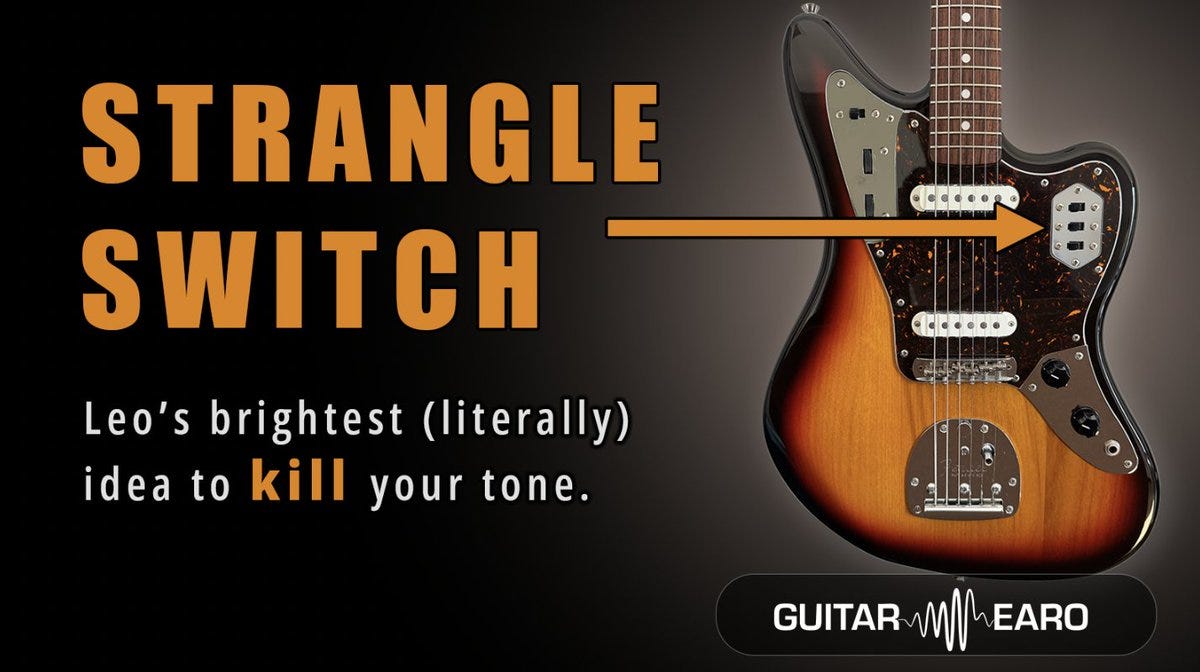
But in his quest for clarity, Leo made a decision that would divide guitarists for decades: he added a switch that literally strangled the guitar’s low end.
It was a tone control designed not to shape your sound, but to remove part of it. Fender engineers named it the “Bass Cut” switch, but players quickly gave it a better name:
The Strangle.
Leo’s vision: brightness above all
To understand why the Strangle switch exists, you have to remember what Fender was chasing in the early ’60s.
Gibson guitars dominated jazz and blues with dark, sustaining tones.
Fender’s vision was the opposite: tight, snappy, crystal-clear sound, perfect for the surf and instrumental rock scene that was booming at the time.
The Jaguar was his technical masterpiece:
A 24-inch scale for faster fretting and tighter strings.
A floating tremolo system with a lock button for stability.
A maze of chrome switches and rollers for instant tone changes.
But its real oddity was a small toggle marked simply “Bass Cut.”
Flip it up, and the bottom dropped out of your sound.
🎧 Like this kind of tone archaeology?
Subscribe to Guitar Earo’s newsletter for deep dives into the hidden design decisions that shaped electric guitar tone history, from Leo’s lab bench to modern rigs.
What the “Strangle” actually does
Electrically, the Strangle switch inserts a 0.003 microfarad (µF) capacitor in series with the signal path.
That’s a high-pass filter, meaning it blocks low frequencies and lets treble through.
Depending on pickup impedance, it starts rolling off around 600–800 Hz, removing much of the low and low-mid range.
To the ear:
The guitar loses body and warmth.
The attack becomes sharp, nasal, and biting.
It slices through reverb and mixes like a snare drum.
Exactly what surf players wanted.
Exactly what everyone else didn’t.
When you flip the switch, the sound thins dramatically, hence the nickname.
You can almost hear the tone being “strangled” as the bass vanishes.
Surf, sparkle, and “the drip”
For surf players like Dick Dale and The Ventures, the Jaguar’s brightness was a revelation.
Through a Fender amp drenched in spring reverb, that bass-cut gave the guitar a wet, percussive attack known as “the drip.”
The Strangle circuit was essentially a frequency shaper for the surf sound: tight low end, explosive highs, and shimmering presence that cut through pounding drums and crashing cymbals.
What other players saw as “thin,” surf players heard as cutting precision.
It became part of the signature tone of the early 1960s: glassy, metallic, and hyper-articulated.
We’re building the first tone-training app for guitarists, designed to teach you how to hear these subtleties. Think you can tell a Jaguar with the Strangle engaged from one without? Soon you’ll be able to test it at guitar.earo.app
The fall… and the mods
By the late 1960s, rock guitar had changed.
Players wanted thick sustain and fat mids, not treble-laden twang.
The Jaguar fell out of favour, and its complex wiring became a liability.
The Strangle switch was one of the first things to go.
Owners routinely rewired or bypassed it to reclaim their low end.
It didn’t help that the rest of the Jaguar circuit was idiosyncratic too, with separate rhythm and lead circuits, multiple switches, and a short scale that made it feel more like a quirky cousin to the Strat than a step up from it.
By the mid-1970s, the Jaguar was discontinued.
The Strangle switch died with it… at least for a while.
The resurrection
Then came punk and alternative rock.
Guitarists like Tom Verlaine (Television), Johnny Marr (The Smiths), and later Thurston Moore (Sonic Youth) rediscovered the Jaguar and Jazzmaster precisely because of their “wrong” tones.
What had once been a flaw (that strangled, wiry attack) became the sound of rebellion.
Suddenly, that too-bright, too-weak switch was the secret weapon for cutting through distorted bass-heavy mixes.
It turned clean tones into wiry stabs and overdriven tones into cutting, articulate chaos.
The Strangle switch became cool again: not as a feature, but as a statement.
Articles like this are part of our mission at Guitar Earo: to document how engineering accidents became the DNA of entire genres.
Subscribe now to get our next deep dive straight to your inbox.
Frequency in context
To put numbers on it:
With the switch off, a Jaguar’s pickup covers roughly 80 Hz–6 kHz.
With it on, frequencies below ~700 Hz are attenuated by about 10 dB.
That’s massive.
You’re literally removing a third of the guitar’s fundamental range.
But that’s also why it sits perfectly in a band mix: the bass and drums occupy the lows, leaving the “strangled” guitar in its own clear space.
What Leo built for surf became, accidentally, the ideal punk EQ.
Why it matters
The Jaguar’s Strangle switch is a reminder that great tone isn’t always about adding: sometimes it’s about subtracting.
It’s also proof that context defines tone:
In 1962, it was too sterile for blues players.
In 1980, it was the perfect sound for downtown New York.
In 2025, it’s a cult circuit mod that builders still debate.
Even Fender’s modern reissues kept the Strangle switch.
They know it’s part of the legend.
🧩 Takeaway
Every guitarist has that moment where they chase “more.”
More lows, more sustain, more warmth.
But the Strangle switch shows how less can be the sound of innovation.
It’s a tiny toggle that tells the entire story of electric guitar evolution: from engineering logic to musical rebellion.
Leo Fender built it to make guitars cleaner.
Players used it to make guitars meaner.
Want to hear what “meaner” sounds like?
We are capturing the tonal DNA of iconic guitars like the Jaguar - so you can train your ear to recognise them blind. Check out guitar.earo.app
For tone nerds: circuit breakdown
Capacitor value: 0.003 µF
Filter type: 1st-order high-pass
Cutoff frequency: ~720 Hz (with 1 MΩ load, typical Jaguar input impedance)
Result: -6 dB/oct roll-off, roughly -10 dB below 400 Hz
Switch type: SPST on the “lead circuit” of the Jaguar wiring scheme
Modern players sometimes mod this with:
A 0.0047 µF cap for slightly less extreme cut
Or a push-pull pot to engage it without the original switch clutter
But the sonic fingerprint remains the same: lean, bright, biting, unmistakably Jaguar.
💬 The Irony
Leo Fender built the Strangle circuit to make the Jaguar more versatile.
Instead, it pigeonholed the guitar for decades.
He wanted to help players cut through the mix and in the process, he created a feature that literally cut out the mix.
Yet that “mistake” gave the world one of the most distinctive tones ever recorded.
A frequency curve so thin it came full circle and became cool again.
The final word
The Fender Jaguar’s “Strangle” switch wasn’t an accident.
It was an overcorrection: a designer chasing purity in a world that wanted dirt.
And like all great mistakes in guitar history, it found its true purpose in the hands of players who broke the rules.
Learn the Tone. Save the Sound.
If you loved this kind of tone archaeology, subscribe to our Guitar Earo newsletter for more deep dives into legendary guitar quirks, mods, and the physics of sound.
And check out guitar.earo.app — where we’re building the first tone-training app that lets you learn to hear the difference between guitars, circuits, and pickups.