
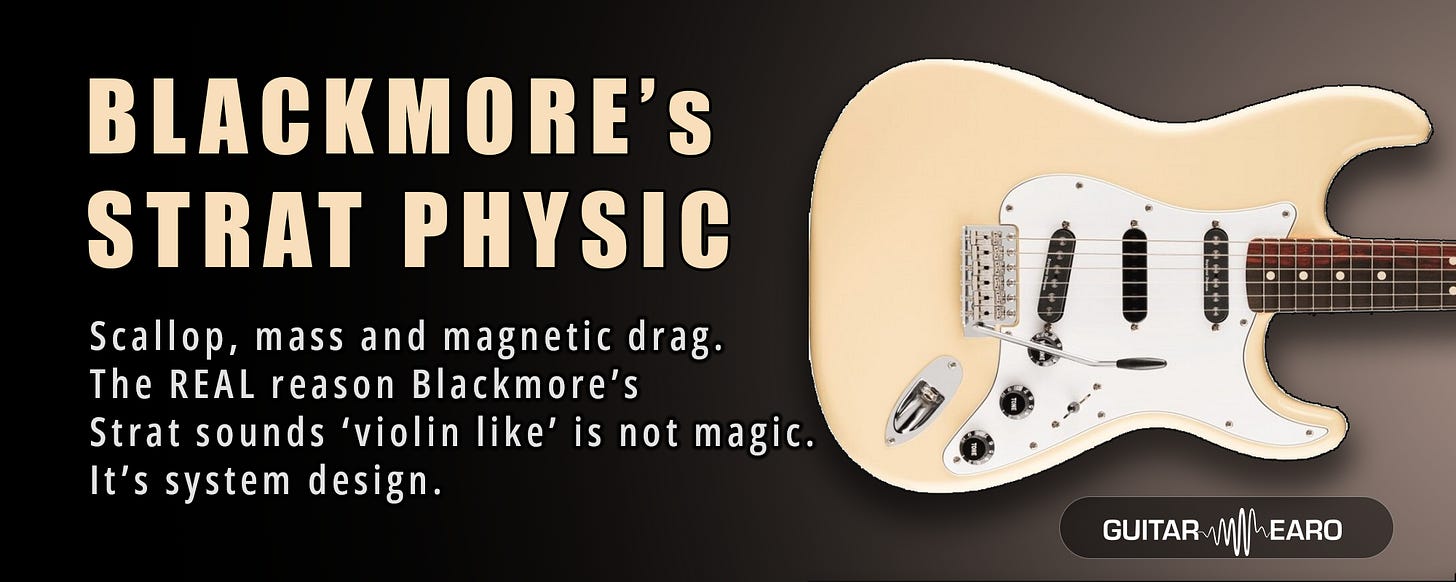
Ritchie Blackmore is often described in vague terms: neoclassical, violin-like, aggressive but articulate. Those descriptors are accurate but incomplete. Blackmore’s tone was not the product of mysticism or fingers alone. It was the result of a systematically modified electromechanical instrument, optimised around touch sensitivity, dynamic range, and controlled sustain.
This article is not about mythology. It is about why his Strat behaved differently, and how each modification altered the guitar’s physical and electrical response.
1. Scalloped fretboards: removing damping from the system
By late 1972, Blackmore had begun sanding concave scallops between the frets of his Stratocaster necks, initially from around the 12th fret upward, later extending to a fully scalloped board.
Mechanical implications
On a standard fretboard, a fretted note involves:
string contact with fret crown
incidental finger contact with wood
That second contact point introduces damping. When Blackmore removed the wood between frets:
the finger never contacts the fretboard
only string ↔ fret interaction remains
Result:
increased initial transient brightness
reduced energy loss into the neck wood
enhanced control over pitch via vertical finger pressure
This is why Blackmore’s vibrato feels cello-like: scalloping enables axial pitch modulation (vertical micro-bends) in addition to lateral string bends.
Interaction with fret size
Blackmore paired scallops with super-jumbo fretwire.
Tall frets:
further isolate the string from the board
reduce required fretting force
increase pitch sensitivity per gram of pressure
This is a high-gain control surface. The downside (intonation instability for heavy-handed players) was irrelevant to Blackmore, who deliberately trained a light touch.
2. Tremolo system: mass, compliance, and stability
Blackmore’s tremolo system was anything but stock.
Heavy steel vibrato arm
He replaced the standard Fender trem arm with a ~¼” solid steel bar, drilling the trem block to accept it.
Why this matters:
Increased arm mass raises the system’s inertial resistance
Less parasitic flex during aggressive dives
Subjectively stiffer feel → more predictable return to pitch
There is also a secondary effect: additional mass at the bridge subtly alters energy reflection back into the string, contributing to sustain under vibrato use.
Partial trem blocking
Rather than fully decking the bridge, Blackmore tightened the claw significantly to:
eliminate upward travel
retain downward pitch modulation
improve tuning stability
This created a semi-constrained oscillatory system: less sympathetic motion, fewer pitch artifacts during bends, but still expressive.
3. Pickup strategy: output is not power
Early period: stock pickups, unconventional filtering
In the late ’60s and early ’70s, Blackmore used largely stock Strat pickups paired with a 0.1µF tone capacitor (twice the value commonly used today).
Electrical consequence:
lower resonant peak
earlier high-frequency roll-off
perceived thickening without compression
This is critical: Blackmore was not chasing brightness at the guitar. He was shaping spectral balance before gain stages.
Schecter F500T era: hot pickups, underused
By the Rainbow period (circa 1979), he moved to Schecter F500T single-coils—high-output designs by spec. However, Blackmore had them coil-tapped to run at reduced effective turns.
Why detune a hot pickup?
lower inductance → higher clarity
improved transient response
wider usable dynamic range
He rejected onboard output in favor of external voltage gain, preserving note definition.
4. Magnetic load management: the missing middle pickup
Blackmore often removed or drastically lowered the middle pickup.
This achieved three things:
eliminated physical pick collision
reduced total magnetic pull on the strings
decreased overall circuit loading
Reduced magnetic drag improves:
sustain
harmonic accuracy on bent notes
vibrato smoothness
This is not folklore—it is basic electromagnetic interaction.
5. Control topology: simplification as signal integrity
Blackmore frequently rewired his Strat controls:
single master tone for neck + bridge
second tone pot removed, repurposed, or left as a dummy
occasional neck-only volume blend
Fewer components in circuit =:
lower cumulative capacitance
less high-frequency attenuation
more predictable response when riding controls
This wiring philosophy aligns with his playing style: continuous micro-adjustment, not preset tones.
6. Gain architecture: external boosts over pedals
Blackmore achieved sustain via:
AIWA reel-to-reel tape preamp (used as a line booster)
Hornby Skewes treble booster
Marshall Major 200W heads
Key insight:
Gain was applied after tone shaping, not before.
This preserved articulation while allowing extreme sustain. Underwound pickups feeding a clean boost behave radically differently than overwound pickups hitting a pedal.
Listen to:
“Catch the Rainbow” intro: wide dynamic headroom
“Kill the King” live: cutting highs without mud
“Child in Time”: sustained fundamental without compression smear
7. The emergent result: a Strat that isn’t a Strat
Summed together, these choices created a guitar that:
bends like a Les Paul
articulates like a Strat
sustains like a violin
responds like a bowed instrument under gain
Many listeners misidentified Blackmore’s tone as:
semi-hollow
synth-derived
or heavily processed
In reality, it was a mechanically and electrically optimised Stratocaster, engineered around feel first, frequency second.
8. Legacy: from heresy to standard practice
Blackmore’s scalloped necks were once viewed as extreme. Today:
Fender produces them stock
Yngwie Malmsteen built a career on the concept
jumbo frets + light touch are mainstream
Blackmore’s real contribution was not scalloping itself—it was proving that instrument response is as important as tone.
He didn’t modify guitars to sound different.
He modified them to behave differently.
And once you understand that distinction, his tone stops being mysterious, and becomes inevitable.