On the first day of the year, every guitarist is quietly renegotiating their identity.
Not their pedalboard. Not their pickups.
Their role.
Because in 2026, an uncomfortable truth is impossible to ignore:
An algorithm can already get your recorded guitar tone 80–95 percent “right” faster than you ever could.
And for the first time in electric guitar history, the bottleneck is no longer sound quality.
It is decision-making.
This is not another “AI is coming” article.
AI is already here, sitting inside mastering chains, amp sims, EQ matchers, and tone assistants.
The real question is more personal:
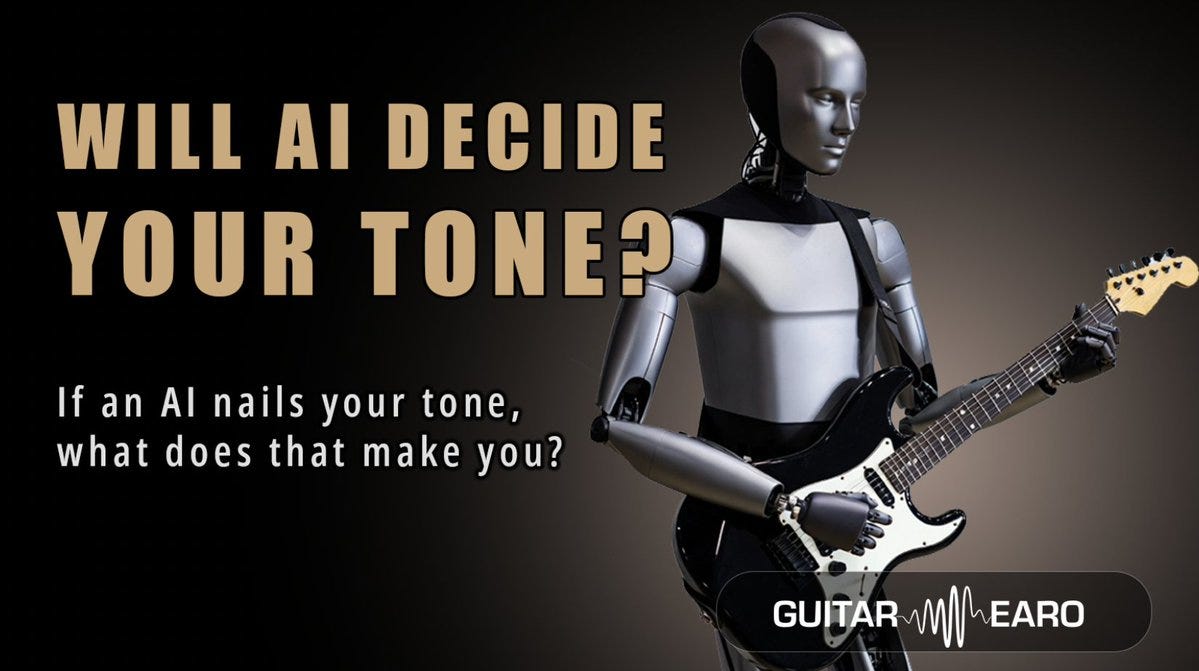
If an AI nails your tone, what does that make you?
Guitar Tone was never just sound
Let us be clear about something before we talk technology.
Guitar tone has never been about frequency balance alone.
If it were, the electric guitar would have converged to a single optimal design decades ago.
It did not.
Instead, tone emerged from:
Accidents
Limitations
Personal taste
Cultural context
Mistakes that stuck
The electric guitar itself was not designed by professional industrial designers.
It emerged from DIY tinkering, backyard experimentation, and people who did not know the rules well enough to follow them.
Bad neck joints.
Microphonic pickups.
Underpowered amps pushed too hard.
Gear used incorrectly, loudly, and repeatedly.
Tone history is a catalogue of wrong decisions that felt right.
That matters, because AI does not make wrong decisions.
It makes statistically optimal ones.
What AI is actually good at
Strip away the hype and fear, and AI in music production is very good at three things:
1. Pattern recognition at scale
AI can analyse millions of mixes, masters, and guitar tones.
It knows what usually works:
Average spectral balance
Typical transient shaping
Common dynamic envelopes
Genre-appropriate loudness targets
This is why blind tests are uncomfortable.
When variables are level-matched and context is removed, many listeners cannot reliably tell an AI master from a human one.
Not because AI is artistic.
But because much of modern production has already converged.
2. Speed without fatigue
AI does not second-guess itself.
It does not get tired.
It does not lose perspective after four hours of tweaking a high-mid bell by 0.5 dB.
It gives you a result immediately.
For many creators, especially independent ones, that is enough.
3. Consistency
AI does not have taste swings.
If you want:
“Modern metal rhythm”
“Vintage clean funk”
“Edge-of-breakup blues”
It will give you the centre of that category every time.
And this is where the problem starts.
The Death of the middle
AI does not kill extremes. It kills the middle.
It does not replace:
Visionaries
Radicals
People willing to sound wrong
It replaces:
Competent, average, acceptable tone decisions
The middle 70 percent of production judgement
The “this will do” layer of creativity
That is devastating for one group in particular:
Guitarists who never consciously learned why they like what they like.
For decades, many players outsourced tone decisions to:
Studio engineers
Producers
Internet presets
Amp defaults
Pedal recommendations
AI simply completes that trajectory.
If tone was already delegated, AI makes the delegation frictionless.
The illusion of control
Here is the trap most guitarists fall into:
“I will let AI get me close, then I will refine.”
That sounds reasonable.
It is also where individuality quietly dies.
Because once you accept the AI’s starting point as “correct”, every human decision becomes a deviation you must justify.
You are no longer choosing.
You are editing.
And editing is psychologically conservative.
You nudge.
You polish.
You rarely overturn the premise.
This is why so much modern guitar tone feels interchangeable even when it is technically excellent.
It is optimised, not authored.
What humans still do that AI cannot
Despite the panic, there are things AI fundamentally cannot do.
Not because of compute.
But because of embodiment.
1. Intentional constraint
Humans choose limitations on purpose.
One guitar
One pickup
One amp
One mic
One take
AI removes constraints to improve outcomes.
Humans impose constraints to create identity.
2. Emotional context
A guitarist knows:
Why a note should hurt
Why a bend should almost break
Why clarity is sometimes the enemy
AI does not know what a song means.
It only knows what similar songs did.
3. Cultural memory
Tone is cultural shorthand.
A Tele bridge pickup does not just sound bright.
It references decades of usage, rebellion, genre, and posture.
AI can mimic the sound.
It cannot originate the meaning.
The new divide among guitarists
This year, the guitar world will quietly split into two groups.
Group One: approval mode
Let AI dial the sound
Approve or reject
Focus on output, speed, consistency
Tone as a utility
There is nothing wrong with this.
But it is no longer craft.
Group Two: authorship mode
Use AI as a microscope, not a compass
Treat suggestions as data, not answers
Maintain responsibility for decisions
Tone as identity
This group will be smaller.
And louder.
The hard question you cannot avoid
The question is not:
“Is AI good or bad for guitar tone?”
The real question is:
When tone decisions become effortless, will you still care enough to make them?
Because once the struggle disappears, so does the excuse.
If an AI nails your tone, and you accept it without resistance, what does that make you?
A guitarist?
Or a curator of acceptable sounds?
A New Year challenge
Do not reject AI.
That is fear dressed as purity.
But do not surrender authorship either.
This year, try this instead:
Use AI to show you what average sounds like
Then deliberately move away from it
Learn why you prefer the deviation
Train your ear, not your presets
Tone has always been a fingerprint, not a formula.
The danger is not that machines will sound human.
The danger is that humans will stop sounding like themselves.
If you want more essays that treat guitar tone as craft, culture, and perception, not marketing folklore, subscribe to Guitar Earo.
Learn the Tone.
Save the sound.