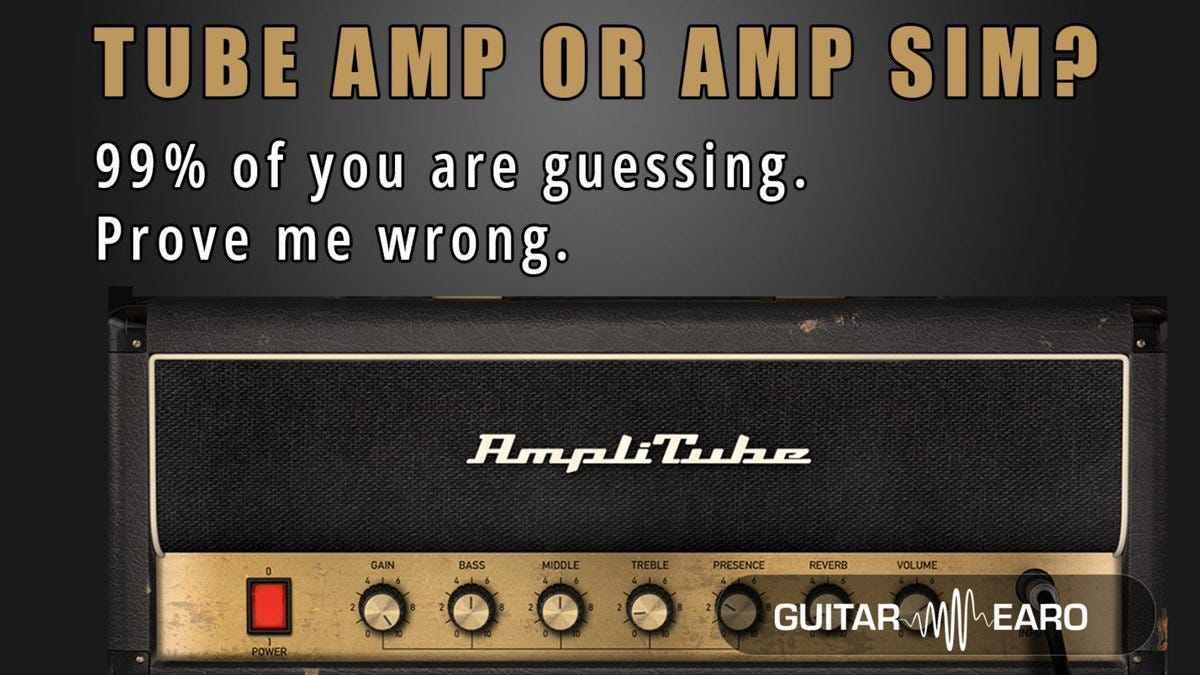
You think you can hear the difference between a tube amp and a modeller?
Prove it.
Every guitarist swears they can. “Tubes are alive.” “Digital is flat.” “Real amps have soul.”
And yet, every time someone takes away the logos and runs a blind test, the confidence evaporates.
The Cult of the Glowing Bottle
Let’s be honest: we’ve built an entire religion around the warm hum of vacuum tubes.
We talk about them like they’re living organisms: responsive, breathing, touch-sensitive.
Tube circuits compress and sag in a way that feels human. They react to how hard you hit the string.
When you roll back the volume knob, the amp “cleans up.”
You can feel the sound bloom beneath your fingertips.
No wonder words like organic, alive, and three-dimensional get thrown around.
Meanwhile, digital modellers get tagged with the ugliest adjectives in guitar culture: sterile, soulless, plastic, flat.
Some even claim a modeller “kills” the natural character of the guitar.
But here’s the twist: those words mostly disappear the moment you take away the labels.
The Thomann Test That Shook People
Thomann once ran a blind video called “Real Amp vs Amp Simulation”.
Thousands of viewers tried to guess which clip was which.
Tube or digital?
Warm or fake?
Everyone was sure they’d nail it.
They didn’t.
Scroll through the comments and you’ll find chaos. Even experienced players split 50/50. Some guessed the modeller sounded more real.
No one could agree: because once you remove sight and bias, the supposed “obvious difference” isn’t so obvious.
Other Blind Tests Tell the Same Story
It’s not just Thomann. The same pattern repeats across forums, podcasts, and studio A/Bs.
When recordings are level-matched, through the same mic and cab IRs, the guessing game falls apart.
Gearspace threads. Rig-Talk shootouts. Reddit blind polls.
Veteran players who’ve spent decades around Marshalls, Fenders, and Boogies routinely get fooled.
And it’s not that their ears are bad. It’s that once you add a mic, a room, and a digital signal chain: you’re no longer hearing the amp.
You’re hearing a recording of a speaker, filtered through converters, compressors, and EQ curves.
That’s where the “tube magic” gets flattened into data.
The Feel Factor (Where Tubes Still Win)
There’s still one thing digital hasn’t perfectly bottled: feel.
Tube amps breathe. They push air.
The feedback loop between the speaker and the strings makes the whole rig feel alive.
You dig in, the amp leans back.
You ease up, it sags and blooms.
That tactile response, that little bit of resistance, is what players describe when they say digital rigs feel “stiff.”
On a recording, it barely matters.
On stage, it absolutely does.
That’s why many pros record with modellers but tour with tubes, or vice versa. It’s not about tone anymore: it’s about feedback and interaction.
The Psychological Divide
The “tube vs digital” war isn’t really about audio.
It’s about identity.
Tube amps are tradition: loud, heavy, and human.
Modellers are change: light, efficient, algorithmic.
If you’ve spent decades defining yourself by your rig, it’s hard to admit a £700 box can sound 98 % the same as your £3,000 stack.
That’s why debates over “feel” often become debates over status.
Owning a valve amp feels like authenticity; using a modeller feels like betrayal.
But the science doesn’t care about our pride.
Blind tests keep showing the same result: once recorded and level-matched, even trained ears can’t reliably tell them apart.
What Actually Matters
Here’s the real kicker: your guitar’s voice survives either way.
A Strat still sounds like a Strat.
A Les Paul still sounds like a Les Paul.
And the nuances that make you sound like you, the pick angle, the phrasing, the vibrato, those live in the playing, not the tubes.
You don’t lose your tone just because there’s code in the signal chain.
If anything, digital tools have democratised it: players can now record professional tones at home, tweak endlessly, and focus on music instead of maintenance.
So Where Do We Go From Here?
The smart take is this: tube amps and modellers aren’t enemies anymore.
They’re flavours of the same thing.
One feels like vintage leather, the other like carbon fibre — both get you to the gig.
Maybe it’s time we stopped arguing about which sounds “real” and started listening to the music again.
Because if you can’t tell the difference in a blind test… does it really matter?