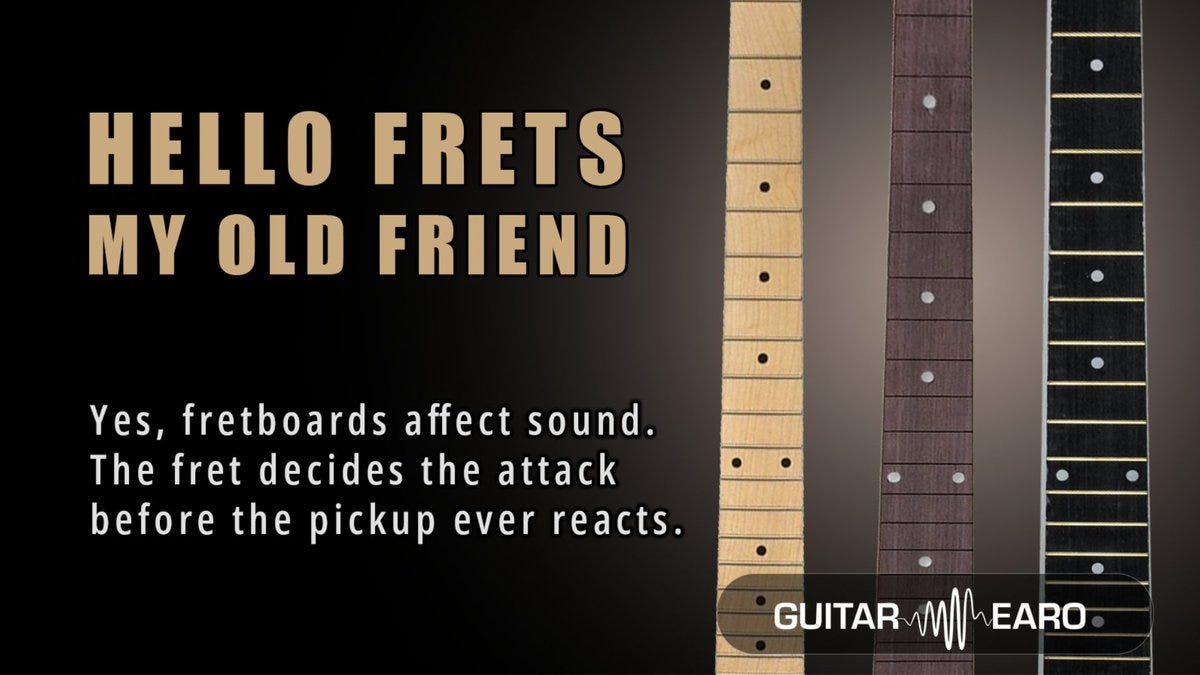
The claim that fretboard wood affects electric guitar tone is often dismissed as placebo or “cork sniffing”. This post examines the problem at the correct physical layer: string termination mechanics, surface impedance, and early-time transient behaviour.
When analysed in the time domain rather than as a steady-state frequency response, fretboard material differences become both explainable and predictable.
1. The common mistake: analysing tone too late in the chain
Most discussions about electric guitar tone start at the pickup. That is already too late.
By the time a pickup generates a voltage, the most important tonal decisions have already happened. Specifically, during the first 10–20 milliseconds after string excitation, when the string’s vibrational modes are being established.
This is not “sustain”.
This is attack formation.
Attack dominates perceived clarity, brightness, articulation, and “snap”. Psychoacoustically, the human ear weights early transients far more heavily than steady-state harmonics.
Two signals with near-identical spectra can be perceived as very different if their attack envelopes differ.
Fretboard material operates exclusively in this early window.
2. The fret as a mechanical boundary condition
When a string is fretted, it is no longer vibrating between nut and saddle. It vibrates between fret crown and saddle.
The fret is therefore a termination point, not just a locator.
At that termination point, energy transfer depends on:
Surface hardness
Density
Elastic modulus
Damping coefficient
Surface finish
Micro-compliance at the fret-seat interface
The fret does not exist in isolation. It is mechanically coupled to the fretboard, which acts as an energy sink or reflector depending on its material properties.
This is the crucial oversight in most debates: the fretboard is not a passive cosmetic slab. It is part of the vibrational system.
3. Time-domain behaviour: where the difference actually lives
Steady-state FFT plots often show minimal differences between fretboard materials. This is frequently used as “proof” that they do not matter.
This is a category error.
The audible differences occur primarily in the time domain, not in long-window frequency averages.
Specifically:
Rate of high-frequency energy reflection back into the string
Damping of upper partials during the first few oscillation cycles
Transient rise time
Perceived sharpness of attack
These effects decay quickly. By the time you are analysing a 500 ms window, they are already averaged out.
But the ear heard them.
4. Material properties of common fretboards
Maple (finished)
Maple fretboards are almost always sealed with lacquer or poly. This matters more than the wood species alone.
The finish increases effective surface hardness and reduces micro-porosity.
Resulting behaviour:
Higher reflection coefficient for high-frequency energy
Faster transient rise time
Slightly enhanced upper harmonic presence
Perceived as “snap”, “bite”, or “immediacy”
Rosewood (unfinished)
Rosewood is porous, oil-rich, and typically unfinished.
Resulting behaviour:
Increased surface damping at very high frequencies
Slight absorption of upper partial energy
Slightly slower transient edge
Perceived as “warm”, “smooth”, or “rounded”
This is not muddiness. It is reduced attack sharpness.
Ebony
Ebony has extremely high density and surface hardness, often left with minimal finish.
Resulting behaviour:
Fastest energy reflection
Minimal high-frequency damping
Tight low end due to reduced energy loss
Perceived as “immediate”, “clear”, “piano-like”
This aligns with why ebony is favoured on instruments where articulation and note separation are prioritised.
5. Why the effect is small, yet important
Measured differences typically fall in the 5–10% range.
That sounds insignificant until you consider how tone actually accumulates.
Tone is not one big variable. It is the sum of many small ones:
String alloy
String gauge
Scale length
Pickup height
Pot values
Cable capacitance
Pick material
Fingertip compliance
Fretboard surface
Each contributes a small shift. Remove enough of them and everything sounds the same. Stack them correctly and character emerges.
Fretboard material is not dominant.
It is contributory.
6. Why gain masks the effect
Distortion compresses dynamic range and flattens transients.
As gain increases:
Early-time differences are reduced
High-frequency content is regenerated non-linearly
Attack distinctions are blurred
This is why players who live on high gain often report no difference, while clean and edge-of-breakup players report clear preferences.
The physics did not disappear.
It was overwritten.
7. Empirical evidence and real-world corroboration
When alternative materials such as baked maple or synthetic composites were introduced due to rosewood shortages, players consistently reported:
Brighter attack
Tighter low end
Increased articulation
Reactions were polarised. That alone is informative.
If a component truly had no effect, it would not provoke consistent directional feedback across large user groups.
Additionally, luthier studies on acoustic instruments show fretboard density correlates with high-frequency overtone behaviour. Electrification does not invalidate mechanical coupling. It merely reduces magnitude.
8. The myth framing problem
The debate is often framed incorrectly as:
“Does fretboard wood dramatically change tone?”
The answer to that is no.
The correct question is:
“Does fretboard material measurably influence string termination behaviour during attack formation?”
The answer to that is yes.
Those are very different claims.
9. Conclusion
The fret is not silent.
The fretboard is not cosmetic.
And tone does not begin at the pickup.
Attack is born at the fret.
If you cannot hear the difference, that does not mean it is not there. It means your signal chain, gain structure, or listening context is masking it.
Tone lives in margins.
And margins are where serious players listen.
Learn the Tone.
Save the Sound.