The Floyd Rose did not show up to make guitars sound better.
It showed up because guitar tremolos were failing.
By the late 1970s, standard vibrato systems had hit their limit. You could add shimmer and mild wobble, but the moment you pushed things hard the guitar went out of tune. Nut friction, saddles slipping, strings binding, tuners creeping.
Dive bombs were a gamble, not a technique.
The Floyd Rose fixed this by doing something very simple and very aggressive.
It stopped the string from moving at both ends.
That one decision changed how the electric guitar behaves, and why people are still arguing about it.
What actually changed mechanically
A string goes out of tune because it slips somewhere. Almost always at the nut or the saddle.
Before locking systems, strings were free to move:
In the nut slots
Under string trees
Over saddles
Around tuner posts
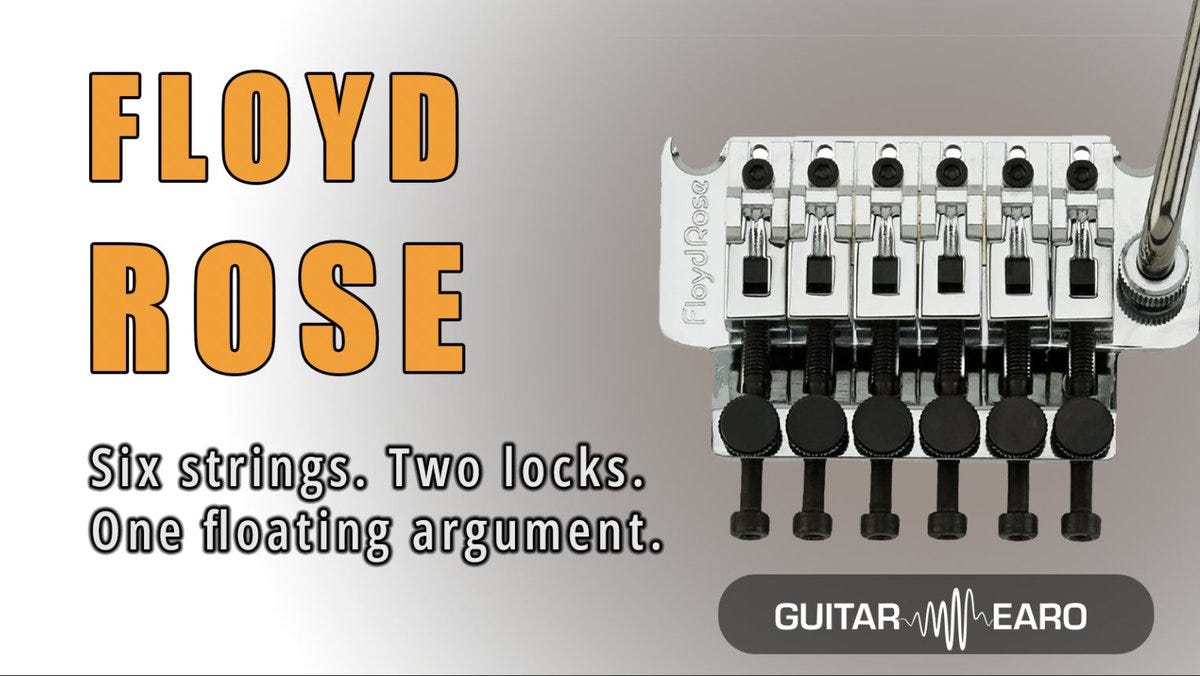
The Floyd Rose clamps the string at the nut and at the bridge. Once tightened, nothing slides. The only things that matter anymore are knife edge accuracy, spring balance, and how well the string recovers elastically.
That is why extreme pitch changes suddenly became repeatable. Dive bombs, flutters, violent pull-ups. They stopped being risky and became usable.
This was not about tone.
It was about control.
Why Floyds do feel and sound different
The tone debate did not come from imagination.
The physics actually changed.
A Floyd Rose alters how energy moves between the string and the guitar.
First, the bridge floats.
When you hit one string, some energy goes into the bridge and springs instead of straight into the body.
That slightly softens the initial attack. It is subtle, but it is real.
Second, the string is no longer anchored directly into wood.
There is a mechanical system in between. That changes impedance and how certain frequencies decay.
It does not kill sustain, but it reshapes it.
Third, all six strings are mechanically linked.
Bend one note and the others react.
That is why chords can wobble and why single notes sometimes feel alive in a strange way.
None of this is magic.
It is just mechanics.
The sustain argument, properly framed
Does a Floyd Rose reduce sustain.
Yes, a bit.
But not enough to matter in the way most people think.
Measured decay times usually differ by less than ten percent compared to a hardtail. What changes more is how the note starts and how the harmonics fade.
What players often describe as less sustain is really a different attack envelope and a different midrange emphasis. At volume, feedback behaviour changes too.
Most people cannot reliably identify Floyd versus hardtail in blind, level-matched listening. They are reacting to feel as much as sound.
Why the 1980s could not exist without it
Take the Floyd Rose out of history and whole styles disappear.
Eddie Van Halen, Steve Vai, Joe Satriani. Their phrasing depends on stable extreme pitch control. You cannot play Eruption on a six screw Strat trem for a full set and survive.
The Floyd Rose turned pitch into a controllable dimension instead of a fragile one. That changed how guitarists wrote riffs and solos.
It did not just enable sounds.
It changed musical thinking.
Tone purity versus expressive range
This is where the argument actually lives.
The Floyd Rose trades a bit of mechanical simplicity for a huge increase in expressive control. It turns the guitar from a mostly passive resonant object into something closer to a precision instrument.
Some players hate that.
Some players build entire careers on it.
Neither side is wrong.
Why people kept modifying it instead of abandoning it
If the Floyd were a tonal disaster, it would have disappeared.
Instead, players added brass blocks, trem stoppers, partial floats, recessed mounts, d-tunas. Not because the design failed, but because it worked well enough to be worth refining.
The Floyd Rose created a new set of variables.
Guitarists did what they always do. They started tweaking.
The honest conclusion
The Floyd Rose did not make guitars sound better.
It made them behave better under stress.
That stability unlocked techniques that reshaped rock and metal. Tone adjusted around that new reality.
You can prefer a hardtail. You can hate setting up a Floyd. You can miss the way a fixed bridge punches you in the chest.
All valid.
But without this bridge, modern guitar would be a much smaller language.
A quiet aside, not a pitch
A lot of these arguments exist because most players never get to hear controlled comparisons. We argue from memory and feel.
I am working on a project called Guitar Earo that is about training your ear to hear these differences without the mythology. If you want to help test it, there is a short form below this post.
No hype, no funnel.
Just early access and feedback.
Learn the tone.
Save the sound.