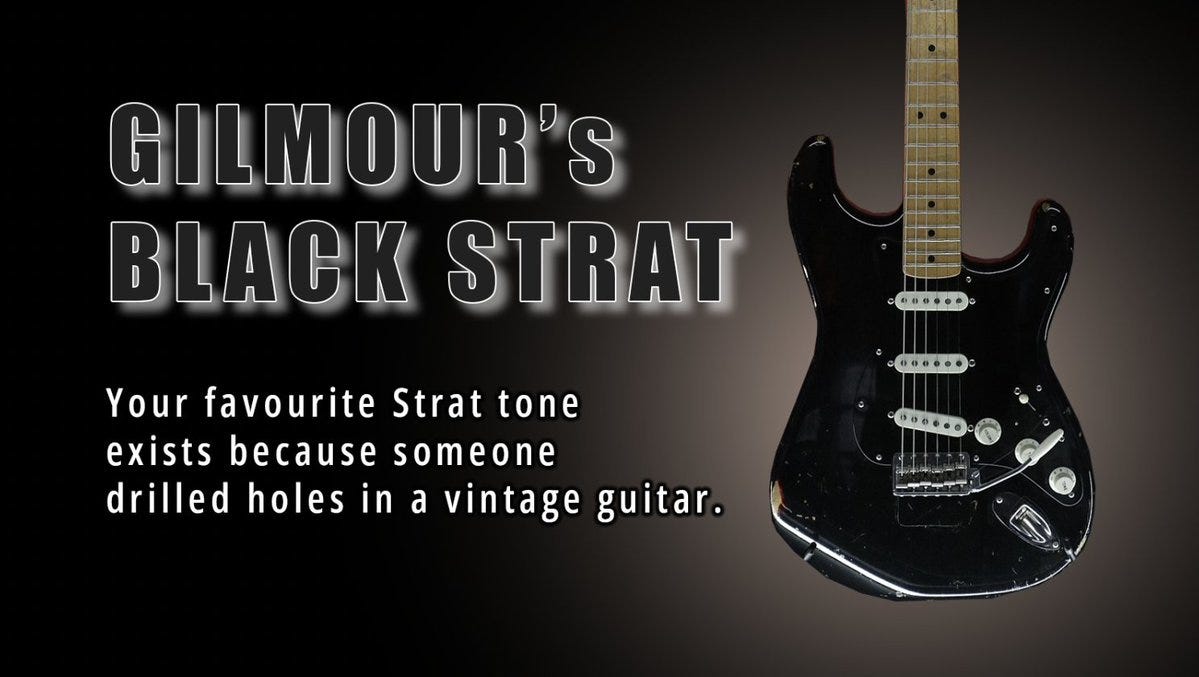
David Gilmour’s Black Strat is routinely cited as evidence that vintage instruments possess inherent tonal superiority. A forensic examination of the guitar’s modification history, electrical topology, mechanical changes and recorded output demonstrates the opposite.
The Black Strat’s tone is not the result of originality, age, or “mojo”, but of repeated, deliberate, and sometimes destructive engineering decisions.
This article analyses those decisions in technical terms and traces their audible consequences across Pink Floyd’s recorded catalogue.
Did you know we are building the world’s first guitar tone training tech? If you want to see what this is about, fill the form below to get a shot to be amongst the first to test it.
The Black Strat as a system, not an artefact
The common mistake in tone discussions is treating a guitar as a static object.
The Black Strat was never static.
From a systems perspective, an electric guitar is an electromechanical oscillator coupled to a transducer network. Any change to stiffness, mass distribution, magnetic field geometry, electrical loading, or pickup topology alters the system response.
Gilmour understood this intuitively long before online tone debates existed.
The Black Strat should therefore be analysed as a mutable signal generator, not as a historically frozen specimen.
Electrical topology: the mini-toggle as a spectral intervention
In 1973, Gilmour added a mini-toggle switch that forced the neck pickup “on” regardless of selector position.
Electrically, this is not trivial.
What this actually changes
A standard Strat offers five pickup combinations (modern wiring):
bridge
bridge + middle (parallel)
middle
middle + neck (parallel)
neck
Gilmour’s mod introduced:
neck + bridge (parallel)
neck + middle + bridge (parallel)
From an electrical standpoint, adding a third pickup in parallel:
lowers total impedance
shifts the resonant peak downward
reduces Q factor
increases high-frequency cancellation due to phase offset between pickup positions
This produces a broader, flatter spectral response with reduced mid-peak emphasis and increased perceived “air”.
This is precisely the texture heard on the clean, shimmering rhythm passages of Shine On You Crazy Diamond.
This tone cannot be recreated with a stock Strat. It is not fingers. It is not amps. It is pickup topology.
Pickup output and midrange density: the DiMarzio FS-1
By the mid-1970s, Gilmour replaced the Fender bridge pickup with a DiMarzio FS-1.
This decision is often misunderstood because it is framed emotionally (“hot pickup”) rather than technically.
FS-1 characteristics
Approximate parameters (historical averages):
DC resistance: ~13 kΩ
Higher inductance than vintage Fender bridge pickups
Stronger midrange emphasis
Lower resonant peak frequency
This matters because bridge pickups on Strats typically suffer from:
low string excursion
reduced fundamental amplitude
exaggerated high-frequency content
The FS-1 compensates by increasing midband energy, improving signal-to-noise under gain, and driving the input stage of fuzz and overdrive circuits harder.
Audible consequences
On Animals and The Wall, Gilmour’s lead tone exhibits:
increased sustain at moderate gain
reduced “ice pick” attack
stronger note fundamentals under compression
This is not accidental. It is the predictable result of higher pickup inductance interacting with cable capacitance and pedal input impedance.
A weak vintage bridge pickup would have produced:
harsher transients
poorer sustain under fuzz
less harmonic density
The FS-1 is not a deviation from “classic tone”.
It is a correction to a known Strat limitation.
Tremolo mass, compliance, and the Kahler experiment
In 1983, Gilmour installed a Kahler locking tremolo, requiring substantial routing.
This is the most instructive phase of the Black Strat’s evolution because it demonstrates mechanical cause and effect.
Mechanical implications of the Kahler
Compared to a vintage Fender trem:
higher bridge mass
altered string break angle
different compliance characteristics
increased damping at the bridge
In mechanical terms, this shifts the system toward:
reduced high-frequency resonance
slower attack
increased energy dissipation into the bridge assembly
Gilmour reported the guitar sounded darker.
This aligns perfectly with the physics.
The reversal
By 1986, the Kahler was removed and the cavity filled with wood. The Fender trem was restored.
This restored:
lower effective mass
higher resonant frequencies
faster transient response
Gilmour famously stated the guitar’s “soul” returned.
Interpreted technically, this is simply a reversion to a higher-Q mechanical system.
This was not superstition. It was long-term empirical testing by a player sensitive to transient response and harmonic bloom.
Neck swaps and stiffness distribution
The Black Strat went through multiple necks:
maple
rosewood
different profiles
different eras
Neck swaps alter:
longitudinal stiffness
modal distribution
attack envelope
While these changes are subtle compared to pickups or electronics, they influence:
perceived immediacy
sustain onset
note separation
The key point is not that one neck was “better”, but that Gilmour treated necks as consumable variables, not sacred components.
This alone contradicts the vintage purity narrative.
Signal chain interaction: why these mods mattered in context
Gilmour’s rig relied heavily on:
fuzz circuits with impedance sensitivity
long cable runs
dynamic picking
Higher pickup output and altered resonant behaviour:
stabilised fuzz behaviour
reduced gating artefacts
increased harmonic density feeding delay and modulation
These mods were not isolated. They were system-level optimisations.
The central myth dismantled
The Black Strat is often mythologised as:
“a magical 1969 Stratocaster”
This is demonstrably false.
The constants were minimal:
alder body
Strat geometry
Everything else was negotiable.
The guitar’s value lies not in preservation, but in iterative optimisation over decades of real-world use.
As David Gilmour himself has stated, it was never the best-sounding guitar inherently.
It became special through use and modification.
Implications for modern tone discourse
The lesson is uncomfortable for collectors and reassuring for players.
originality is not a prerequisite for great tone
modification is not tonal vandalism
reversibility matters more than purity
ears matter more than doctrine
Gilmour’s approach mirrors good engineering practice:
change one variable
listen
keep or revert
That mindset, not vintage correctness, produced one of the most recognisable guitar voices in recorded music.
Conclusion
The Black Strat is not evidence that old guitars are better.
It is evidence that good decisions compound over time.
Tone is not inherited.
It is engineered.
And the moment you stop treating guitars as untouchable objects and start treating them as systems, the mythology collapses.
Learn the Tone.
Save the Sound.