A few weeks ago we ran a simple blind listening test on X.
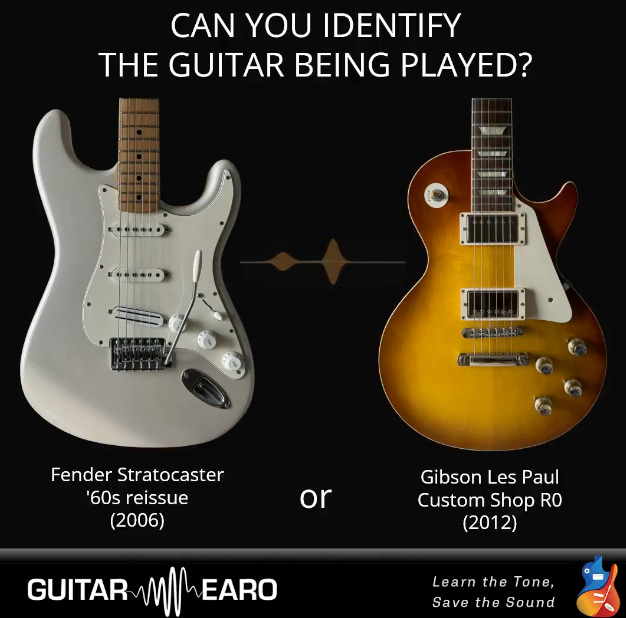
Nothing scientific or too elaborate: just a clip of clean blues lick and a question: “Is this a Strat or a Les Paul?”
Before I go on, if you want to test your own ears (and help us refine our tone-training tech), you can join our tester list here:
These two instruments are supposed to sit at opposite ends of the tonal spectrum:
Bolt-on neck vs. glued-in mahogany set neck
Single-coils vs. humbuckers
Tremolo bridge vs. hardtail
Longer vs. shorter scale length
Bright, scooped attack vs. thicker, mid-forward voice
If any two classic guitars should be easy to tell apart, it’s these two.
And yet…
The majority of players picked Strat, even though the recording was a Les Paul.
Players with decades of experience.
Owners of both instruments.
People who swear they can identify humbuckers blind.
Most chose wrong.
Why so many people got it wrong
The Les Paul in that clip wasn’t doing “Les Paul things” visually: no burst, no humbuckers in frame, no preloaded expectations.
Just the tone.
And when you strip everything else away, you quickly realise something uncomfortable:
Most of what we think we hear comes from what we expect to hear.
Here’s why that specific test fooled so many players:
The performance was cleaner and lighter than the stereotypical LP tone.
People associate Les Pauls with thick, mid-forward lines and singing sustain.
Play it lightly, clean, and with plenty of pick articulation… and the mental category shifts.The pickup position choice matters more than the guitar shape.
A Les Paul neck or middle pickup can easily drift toward what players think of as “Strat-ish,” especially without visual cues.Amp and chain differences overshadow wood and construction.
Most real-world comparisons aren’t standardised.
But in our tests, they are.
Listeners guess based on genre and playing style, not frequency content.
If it sounds like something a Strat player would play, people vote Strat.
This is how bias works, and it’s not a moral failing.
It’s how the brain simplifies complex information.
The bigger picture
This isn’t an indictment of anyone’s ears.
It’s a reminder of how many variables shape our perception of tone:
touch (the ‘tone is in the finger’ debate)
pick attack
dynamics
pickup height
amp EQ
room
monitoring
visual cues
expectation bias
When people say they can “always tell a Les Paul from a Strat,” what they usually mean is:
“I can tell when the recording fits the stereotype.”
But remove the stereotype, and even experienced players stumble.
We’ve seen this repeatedly while building a blind-comparison library of guitars:
players misidentifying their own guitars
misidentifying pickup positions
confusing models within the same brand
assuming tone differences that weren’t there
overlooking differences that were
The surprising thing: non guitarists fare better in our test than experienced guitarist.
Because their ears are less polluted by brand expectations and tonal stereotypes.
Why this kind of testing matters
It’s not about proving people wrong.
It’s about giving players a more honest relationship with their instruments.
If you think a guitar sounds a certain way, you’ll play into that idea.
Blind tests strip away the stories.
And once the stories are gone, the ears start doing the real work.
Some early testers have told us things like:
“I thought I’d easily pick my Les Paul out of a lineup.
Turns out, not even close.”
And someone else:
“I’ve spent years talking about pickup positions.
Turns out I couldn’t reliably identify them until I actually trained it.”
These people are not beginners.
They’re just finally listening without the visuals.
If you want more tests like this
We’re running more blind tone comparisons (including full multi-pickup tests and same-riff multi-guitar sets).
If you want to try them early, you can join our tester list here:
We’re keeping the test group small so the feedback stays useful.
Learn the Tone.
Save the Sound.