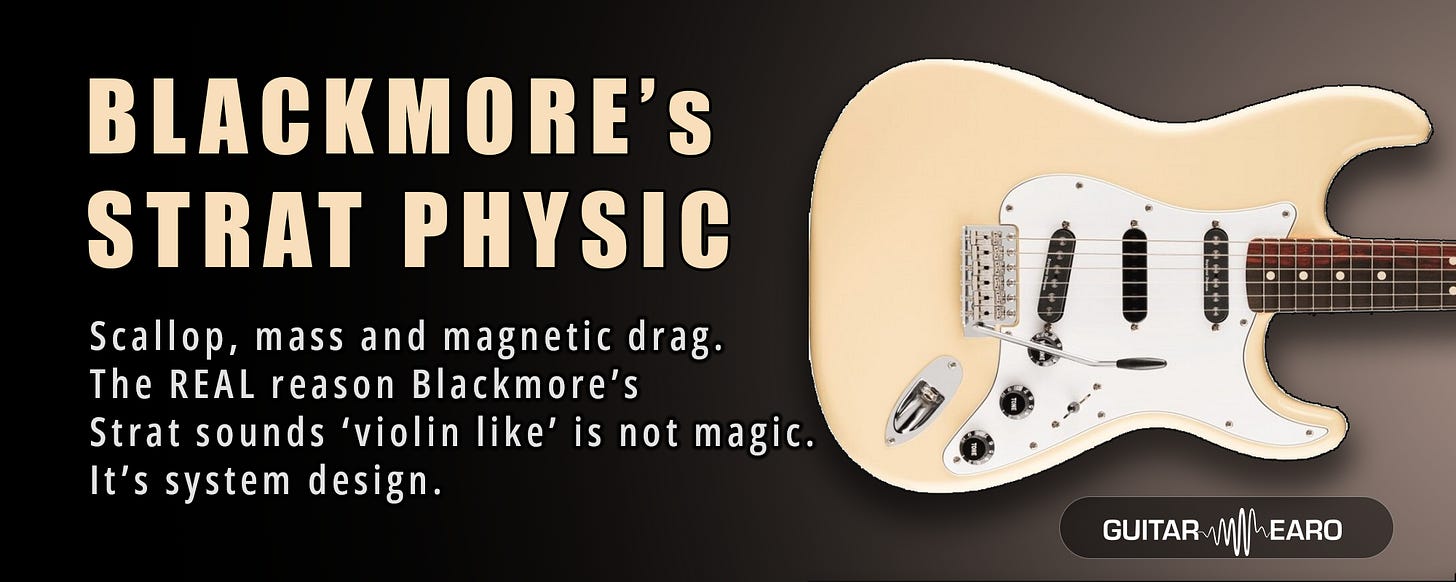

When guitar culture tells its myths, the stories usually orbit flawless vintage instruments, golden-era craftsmanship, or the serendipity of picking the “right” guitar off the rack. Eric Clapton’s Blackie breaks that pattern. It was not built by a revered luthier, nor was it a pristine ’50s specimen. Instead, it was a Stratocaster assembled from the surviving remains of three beat-up late-1950s Fenders Clapton bought for $100 each.
Yet from this Frankensteined collection of parts emerged perhaps the most influential Stratocaster tone of the 1970s.
This post examines why Blackie worked: combining physics, materials science, and guitar-heritage analysis to explain its singular voice.
1. The Neck–Body Coupling: Why a ’57 Soft-V Neck Matters
The neck Clapton chose was from a 1957 Strat, carved into a thick soft-V profile. Two technical observations follow.
1.1 Increased Sectional Mass → Higher Modal Stability
A chunky soft-V neck increases stiffness and reduces unwanted vibrational modes. This leads to:
Fewer dead spots
Slightly longer sustain in mid-register strings
More stable note bloom and predictable decay patterns
These mechanical behaviours explain why Clapton’s phrasing (slow bends that “open up” over time) feels so vocal. The neck was doing real, measurable work.
1.2 Maple’s High Young’s Modulus
Maple transmits upper-mid partials more efficiently than rosewood. Combine that with Clapton’s hybrid-picking attack and you get:
a high-mid–rich transient without the brittle edge typical of brighter Strats.
Side note for readers following our app project:
We are building the world’s first tone training app.
Want early access?
2. The Mismatched Pickups: Tonal Asymmetry That Should Not Work (But Did)
Blackie’s pickups were mismatched:
Two late-’50s pickups
One 1970 unit
A luthier might call this a red flag.
In reality, it became a sonic advantage.
2.1 Inductance Variability and Resonant Peaks
The 1970 pickup’s slightly higher inductance pushed its resonant peak lower, causing:
Warmer high-end rolloff
More mid-forward quack in 2/4
More complexity in multi-pickup phase interactions
Clapton’s bridge+middle quack is unmistakable partly because the pickup set was never designed to match.
2.2 Magnetic Pull Asymmetry
Differences in Alnico ageing produce uneven magnetic fields.
This affects:
Attack slope
Harmonic onset
Transient definition
All contributing to Blackie’s recognisably “elastic” note attack.
3. The Tremolo That Didn’t Trem: Why Blocking the Bridge Changed Everything
Clapton blocked the tremolo: one of the most consequential tonal decisions of his career.
3.1 The Problem with Floating Bridges
A floating trem introduces reactive compliance, meaning the bridge moves in response to string energy.
This causes:
Energy loss
Lower Q-factor
Softer attack envelope
3.2 Why Blocking the Trem Works
By decking and blocking the trem:
Mechanical impedance rises
String energy transfers more directly into the body
Unplugged volume increases
Sustain improves measurably
Clapton’s tech described the change as:
“The guitar got louder, even acoustically.”
This is vibration physics, not folklore.
4. The 5-Way Switch: Codifying the Science of Quack
Clapton added a 5-way selector before it became standard.
Why quack happens:
Pickup spacing (~55 mm)
Slight inductance variance
Phase cancellations between 1.5–3 kHz
Blackie’s mismatched inductances meant its quack was less scooped, more mid-present, and ideal for Clapton’s percussive rhythm lines.
5. System-Level Modelling: Blackie as a Coupled Vibrational Electromagnetic System
When viewed holistically, Blackie was not just a guitar; it was a complex interaction of mechanical and electromagnetic properties:
Blocked trem → increased rigidity
Soft-V neck → stable modal distribution
Pickup mismatch → asymmetrical resonance
Clapton’s dynamics → transient shaping
1950s Fender materials → specific damping profiles
Together, they produced a tone with:
Strong fundamentals
Rounded transients
Extended sustain
Recognisable midrange “chewiness”
A uniquely alive top end
6. From Blackie to the Clapton Signature Strat: Engineering the Missing Midrange
Blackie’s limitations led directly to the 25 dB mid-boost and TBX circuit developed in the mid-1980s.
In essence:
Blackie taught Clapton what he wanted more of
The Signature Strat engineered those qualities deliberately
7. Blackie’s Legacy: Imperfection as a Feature, Not a Defect
Blackie is lasting proof that perfection is not the goal of tone.
The goal is coherence.
A too-perfectly matched pickup set might sound sterile.
A floating trem might reduce desirable transient energy.
A slim neck might introduce unhelpful modal chaos.
Blackie’s genius was accidental alignment: a system whose flaws complemented each other into musicality.
If you want to see are building the world’s first ear-training system for electric guitar tone, let us know below.
Learn the tone.
Save the sound.