The 1956 Gibson/Gretsch letters are real, and so are the two patent filings.
Once you line them up, the usual humbucker story falls apart:
22 Jun 1955
22 Jan 1957
Summer NAMM 1957
The humbucker wasn’t born once. It was born twice, and that’s why PAFs and Filter’Trons still feel like different religions.
Most guitarists inherit a simplified version of this story
Seth Lover invents the humbucker at Gibson.
Gretsch does its own version. The PAF becomes the myth. The Filter’Tron becomes the quirky cousin. End of story.
Neat. Clean.
Wrong.
Because once you actually line up the dates, the patents, the letters, and the rollout, you stop looking at a single invention and start looking at a race. Not a metaphorical race. A real one, with two companies, two engineers, a rising noise problem, and enough overlap to make Gibson’s president send warning letters before the public even saw both pickups side by side.
That matters because guitar history is usually written backwards from fame.
The PAF became the most mythologized humbucker in the world, so people assume it must also have the cleanest origin story. It doesn’t. Seth Lover’s patent was filed on 22 June 1955 and granted on 28 July 1959. Ray Butts’ patent was filed later, on 22 January 1957, but granted earlier, on 30 June 1959. Those are not internet-forum fantasies. They are the filing records.
Then come the letters.
Archival reporting on the Butts papers shows Ted McCarty of Gibson writing to Ray Butts in October and November 1956, making clear that Gibson knew Gretsch was moving toward a humbucking pickup and warning that Gibson already had a patent application on file. In other words: before the great public launch moment, both sides already knew there was another player on the field. The famous “who was first?” debate was not invented decades later by collectors. It was there, inside the period itself.
That is where the usual humbucker story begins to crack.
Because now the timeline stops looking like one company inventing the future while another follows. It starts looking like parallel invention under pressure.
The Gretsch side
On the Gretsch side, the pressure had a name: Chet Atkins.
Atkins disliked the DeArmond pickups on his Gretsches. He complained about hum. He also complained about sustain and balance. In later recollections, he described twisting his body around the amp just to reduce the noise, and remembered Ray Butts showing up with “a pickup that doesn’t hum.” Multiple later histories place Butts’ first working humbucking concepts around 1954, and authenticated photos show Atkins playing a black Gretsch 6120 prototype with Butts’ pickups by September 1956.
That is the first thing people miss.
The humbucker was not just an engineering exercise. It was a player problem before it was a patent problem.
Chet Atkins did not wake up wanting “more output.” He wanted less hum, better balance, less magnet pull, and a cleaner professional sound. Ray Butts was not trying to invent mythology. He was trying to solve a working musician’s irritation.
The Gibson side
On the Gibson side, Seth Lover approached the problem from a different institutional context.
Lover later explained that the humbucking idea grew out of his familiarity with humbucking choke coils used in amplifier design. Ted McCarty did not reportedly hand him a poetic brief about changing guitar history. He wanted a better pickup. Lover filed in 1955, and Gibson began building its version before the patent was granted, which is exactly why those famous little “Patent Applied For” stickers appeared in the first place.
That is the second thing people miss.
The PAF was not born as a museum object. It was born as an industrial solution.
Only later did it become the holy relic of late-’50s Gibson culture.
The two sides collide in 1957
Then comes Summer NAMM 1957, the third date that matters.
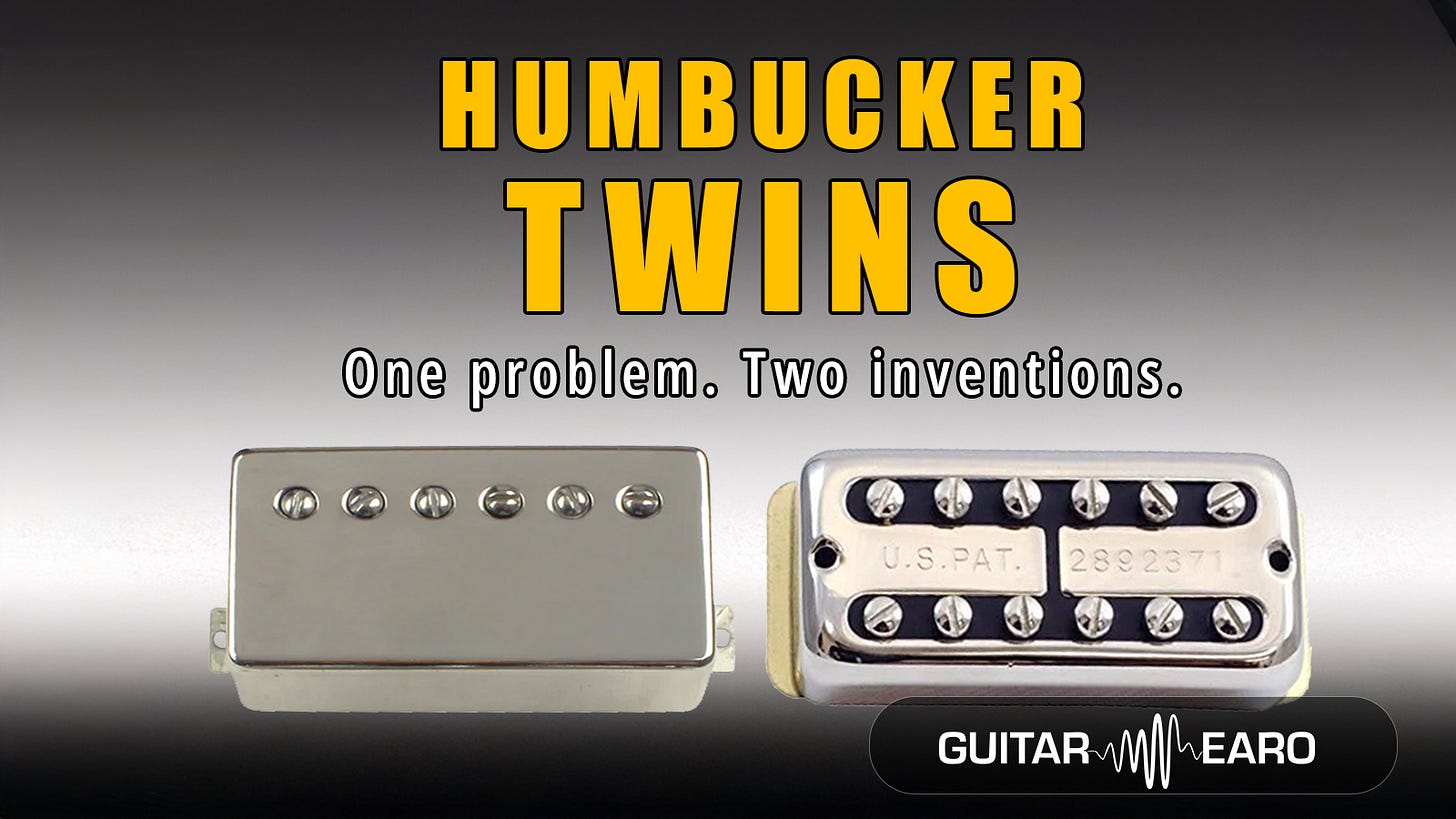
This is the public collision point. Later reporting from guitar historians notes that both designs debuted at the 1957 Summer NAMM Show. Gibson had its new humbucker. Gretsch launched the Filter’Tron Electronic Guitar Head. And from that point on, the argument was no longer theoretical. The market could hear two answers to the same question.
Same problem. Different religion.
That is the real heart of the story.
Because the most important thing about PAFs and Filter’Trons is not that both kill hum. It is that they do not feel like the same sonic philosophy at all.
The PAF became the thicker, broader, richer answer. More wire. Wider coils. More of that muscular Gibson push. The Filter’Tron went narrower: taller, tighter coils, bigger magnet, lower DC resistance, more clarity, more snap, more treble structure, more separation between notes. Reverb’s pickup histories and later technical explainers all land in roughly the same place: a Filter’Tron is narrower than a PAF, its bobbins are taller, its magnet is larger, and its sound stays clearer and brighter even while canceling hum.
That is why this story still matters.
Not because of vintage-parts trivia.
Not because two old patents make for a cute nerd argument.
But because this is the moment where electric guitar tone splits into two distinct humbucking futures.
One future becomes Gibson’s thick authority: bloom, chew, midrange gravity, the sound that later rock players would treat as scripture.
The other becomes Gretsch’s articulate shimmer: snap, bite, air, the strange miracle of hum-free tone that still keeps enough single-coil-like definition to dance instead of just roar.
And once you hear the story that way, a lot of later guitar culture suddenly makes sense.
Why does a Gretsch player sound almost offended when someone says “just put humbuckers in it”?
Why do vintage Gibson people talk about PAFs like they are theology rather than components?
Why do so many pickup debates secretly reduce to a fight between clarity and mass, bite and bloom, twang-preserving hum cancellation and fatness with authority?
Because the split is old. Older than most players realise. It was already there when the public first met these designs.
One more thing...
There is another twist, too.
The wider history of hum-canceling pickup design complicates the chest-thumping “who invented the humbucker?” question even further. Guitar historians have pointed to earlier dual-coil patents in the 1930s, including Armand Knoblaugh’s work, which means neither Gibson nor Gretsch invented the hum-canceling principle from nothing. What they did do was turn that principle into iconic guitar products with radically different tonal consequences. That distinction matters.
So no, the humbucker was not born once.
It was born once as a problem.
Once as a filing.
Once as a rival answer.
And finally as a public split in the sound of the electric guitar.
That is why the three dates matter so much:
1954: Chet Atkins is already pushing Ray Butts toward a hum-free pickup solution.
22 June 1955: Seth Lover files Gibson’s humbucker patent.
Summer NAMM 1957: the two great humbucking bloodlines meet the public.
Once you line those up, the usual story falls apart.
And in its place you get something much better:
Two inventors.
Two companies.
Two answers to the same technical problem.
And two tone cultures that still haven’t merged.
The PAF did not simply win.
The Filter’Tron did not simply survive.
They divided the humbucker world between them.
That division is still ringing every time someone chooses a Les Paul over a Country Gentleman, every time someone hears “warmth” where another hears “mud,” every time someone says they want a pickup that can snarl without smearing the note.
The paperwork is old. The argument is not. Every time a player chooses bloom over bite, mass over clarity, or a Les Paul over a Country Gentleman, they are still choosing between the two humbucker futures that collided in the 1950s.
Learn the Tone.
Save the Sound.